
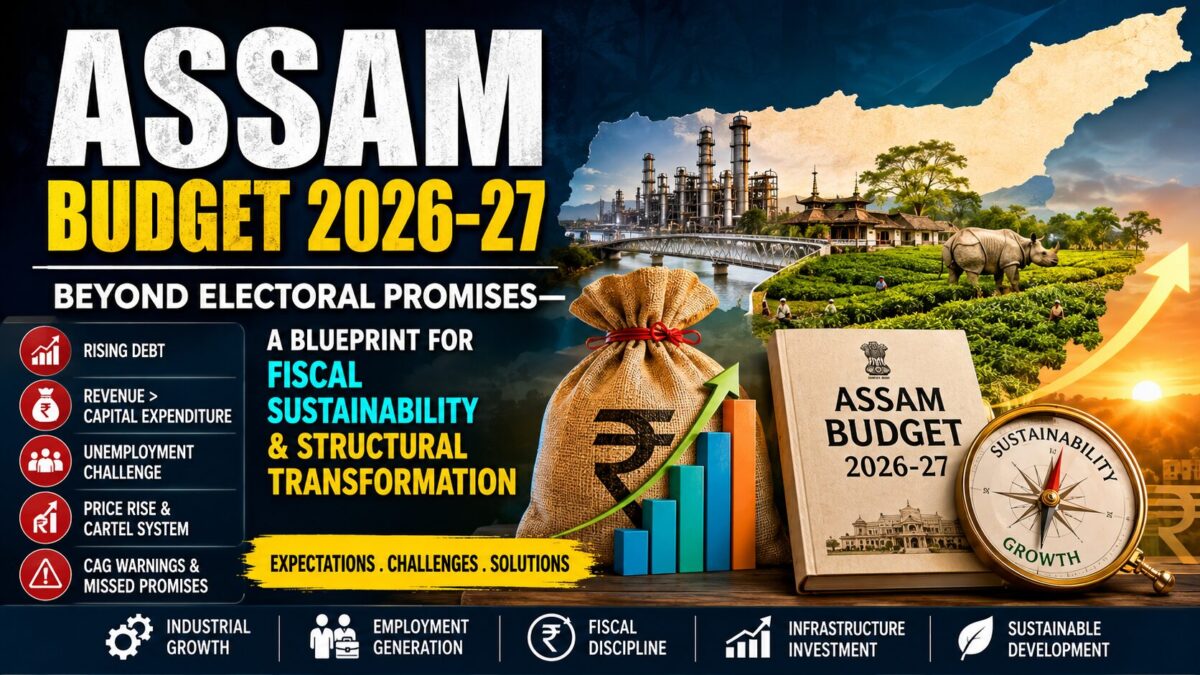
As Assam Chief Minister Himanta Biswa Sarma prepares to unveil the state’s economic roadmap for the next five years, the upcoming Assam Budget 2026–27 stands at a historically significant crossroads. The administration faces a classic macroeconomic paradox: the mandate to fulfill ambitious electoral welfare commitments while simultaneously engineering a structural shift toward a self-sustaining, investment-led economy.
Over the past half-decade, Assam has made commendable strides in digital governance, infrastructure connectivity, and high-tech investment attraction—most notably in the semiconductor and electronics manufacturing spaces. Yet, beneath these headline achievements lies an uncomfortable fiscal reality. Escalating public debt, a disproportionate reliance on revenue expenditure, and localized structural bottlenecks threaten to choke the state’s long-term growth potential.
The fundamental question governing the Assam Budget 2026–27 is simple yet profound: Can the state transition from a consumption-driven, welfare-dependent model to a highly productive, capital-aligned economy without triggering a fiscal crisis?
1. The Hard Fiscal Reality: Quality vs. Quantity of Expenditure
In nominal terms, Assam’s Gross State Domestic Product (GSDP) has charted a highly encouraging upward trajectory. However, an expanding GSDP can mask severe structural vulnerabilities if that growth is primarily fueled by public borrowing rather than private capital formation or organic tax revenue increases.
Data from the Comptroller and Auditor General (CAG) and recent PRS legislative analyses consistently signal the need for stricter expenditure discipline. In recent fiscal cycles, the state’s revised fiscal deficit has breached target thresholds before correcting. When an economy relies heavily on debt to sustain its momentum, it inevitably faces diminishing fiscal space as debt-servicing costs swallow future revenues. The upcoming budget must pivot from measuring the quantity of public spending to rigorously auditing the quality of that expenditure.
2. The Structural Imbalance: Revenue vs. Capital Expenditure
The core challenge within Assam’s public finance framework is the persistent dominance of revenue expenditure—recurring outlays such as government salaries, pensions, subsidies, and welfare schemes. While these funds support immediate consumption and social safety nets, they do not create long-term productive assets.
Conversely, Capital Expenditure (CapEx) funds the construction of highways, multi-modal logistics hubs, specialized industrial parks, and research institutions—the literal engines of future economic returns.
Global macroeconomic evidence confirms that sustainable, long-term GSDP growth is directly correlated with aggressive capital formation rather than the continuous expansion of consumption subsidies. To correct this imbalance, the Assam Budget 2026–27 must explicitly detail:
- Clear medium-term targets to systematically scale up CapEx as a percentage of total expenditure.
- Rigorous, department-wise capital investment outcome mapping.
- The estimated Economic Rate of Return (ERR) for all infrastructure projects exceeding ₹100 crore.
3. Managing the Debt Trajectory through Transparency
Borrowing is a highly effective fiscal tool when deployed to build assets that yield returns greater than the cost of capital. However, borrowing to cover recurring revenue deficits is a recipe for fiscal drag.
Assam’s outstanding debt has climbed steadily, and the resulting interest burden threatens to crowd out developmental spending. To restore absolute market and investor confidence, the government should introduce a transparent Medium-Term Fiscal Strategy (MTFS) within the budget documents. This strategy must clearly delineate:
- A predictable path for the state’s Debt-to-GSDP ratio over the next five years.
- An explicit annual interest burden amortization schedule.
- A legal framework ensuring that incremental debt is tied directly to asset-creating capital projects rather than populist consumption transfers.
4. Industrial Transformation: Moving from Announcements to Operating Factories
Assam has captured national attention with high-profile investment announcements in semiconductors, green energy, and downstream petrochemicals. Yet, the chasm between a signed Memorandum of Understanding (MoU) and an operational, tax-paying factory employing local youth remains wide.
The state’s industrial landscape continues to grapple with structurally high logistics costs, a narrow manufacturing base, delayed land utilization, and regulatory friction that disproportionately harms micro, small, and medium enterprises (MSMEs).
Rather than relying on isolated, subsidy-heavy incentive schemes, the Assam Budget 2026–27 should focus on structural, supply-side reforms. Funding must prioritize targeted industrial ecosystems:
- The Semiconductor & Electronics Ecosystem: Providing targeted infrastructure and uninterrupted power/water utilities to ensure anchor projects succeed.
- The Bio-Economy & Agro-Processing: Activating dedicated food processing parks and bamboo-based bio-refineries to tap into the region’s natural comparative advantages.
- Riverine Logistics: Upgrading Brahmaputra-based river logistics to bypass landlocked transport bottlenecks and lower the cost of doing business.
5. Outcome Budgeting: Shifting the Primary Economic Indicator
Economic growth that fails to generate formal, high-quality employment is politically volatile and socially unsustainable. Assam’s historical reliance on self-employment and micro-entrepreneurship schemes must be upgraded.
The state must transition fundamentally from announcement budgeting to outcome budgeting. Every major spending department should be legally required to publish quantified performance metrics alongside their budgetary allocations. Success should be judged against clear indicators.
6. Curbing Inflation, Market Cartels, and Supply-Side Bottlenecks
Macroeconomic growth yields little real-world benefit if localized inflation erodes household purchasing power. Households across Assam continue to face high costs for essential commodities, driven largely by inefficient supply chains and deeply entrenched market cartelization.
Temporary consumer subsidies act merely as an expensive band-aid. The permanent economic solution lies in breaking supply-side bottlenecks and fostering robust market competition. The upcoming budget should fund:
- Integrated Agricultural Supply Chains: Investing heavily in cold storage infrastructure and solar-powered warehousing networks to reduce post-harvest losses.
- Anti-Cartelization Measures: Launching digital auction systems, mandatory e-procurement platforms, and independent market intelligence units to ensure fair competition in public procurement and local trade networks.
7. Maximizing Human Capital and Agricultural Value Chains
Assam’s long-term competitive advantage relies on two foundational pillars: its farmers and its youth.
In agriculture, the policy focus must shift from basic production and minimum support price (MSP) procurement to high-value branding, climate-resilient farming techniques, and direct farmer-to-market digital links.
Simultaneously, the state must aggressively upgrade its human capital. The modern global economy rewards technical literacy. Budgetary outlays for education must pivot away from merely maintaining physical school buildings and toward funding advanced curricula: Artificial Intelligence (AI) training, biotechnology research, vocational nursing programs, and structured university-industry research partnerships.
8. A New Fiscal Architecture for Assam
To codify these changes, the Assam Budget 2026–27 should establish a modernized, institutionalized Fiscal Architecture. This can be achieved by launching a suite of governance tools designed to maximize public trust and operational efficiency:
- Independent Public Investment Evaluation Framework: A non-partisan body to audit the efficacy of major public expenditures before they are renewed.
- Public Debt Transparency Portal: A real-time, citizen-facing dashboard tracking total debt, debt-to-GSDP ratios, and interest obligations.
- District Competitiveness Index: A data-driven framework ranking districts on ease of doing business, employment generation, and infrastructure completion to foster healthy intra-state competition.
- Climate-Resilient Green Budgeting: Expanding environmental accounting to insulate the state’s infrastructure investments from the chronic fiscal shocks of annual flood cycles.
Conclusion: The Path Ahead
The success of the Assam Budget 2026–27 will not be defined by the sheer volume of new schemes announced or the monetary magnitude of its welfare transfers. It will be judged by its structural courage.
By leveraging its strategic geography, improving regional connectivity, and capitalising on favorable demographics, Assam has a historic window of opportunity to build a highly competitive regional economy. The upcoming budget must confidently move beyond short-term political cycles and present a mathematically sound, structurally transformative blueprint that guarantees a prosperous, self-sustaining future for every citizen of Assam.