
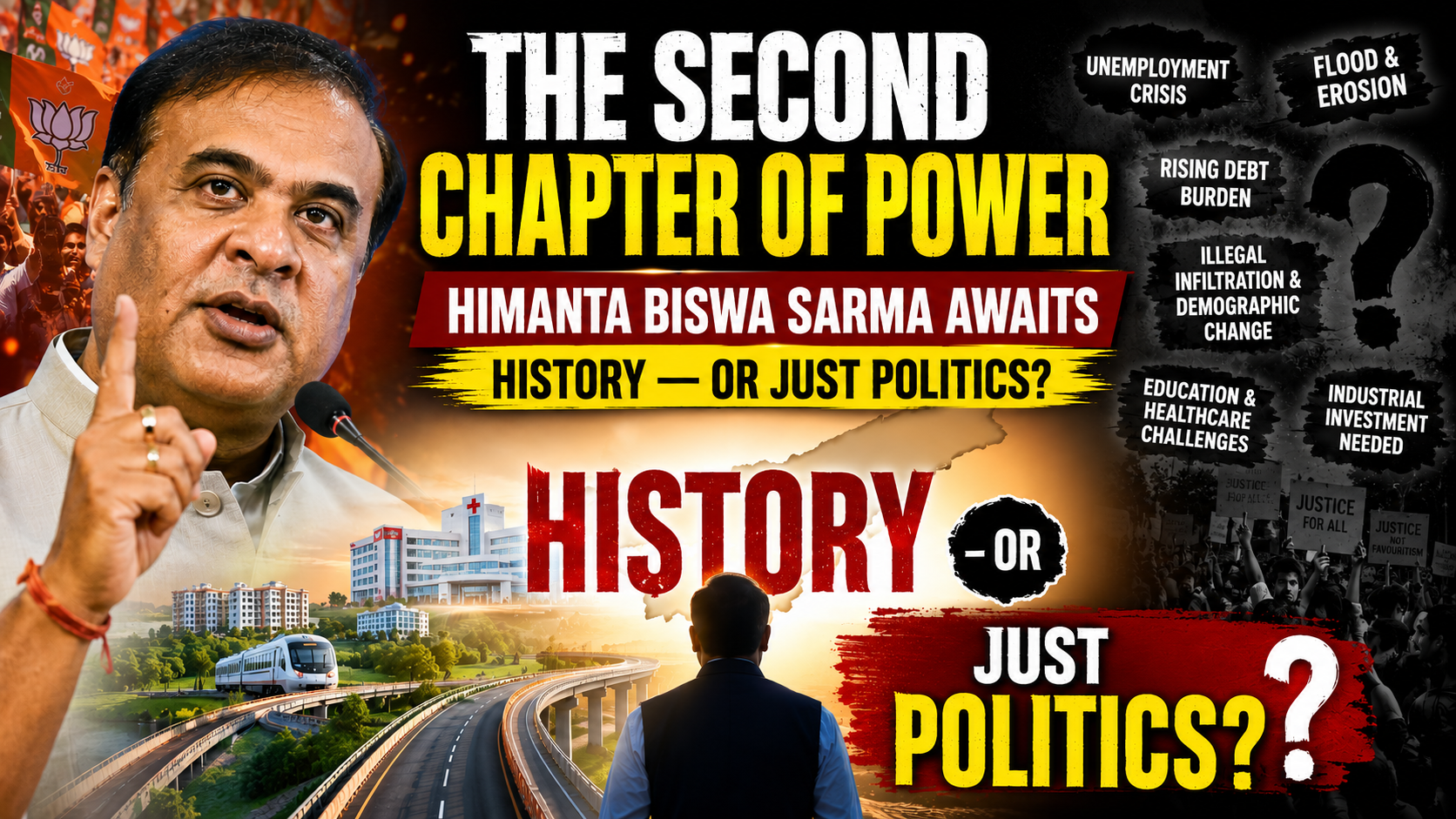
Dr. Himanta Biswa Sarma is not merely a politician — he is one of the most remarkable figures in the modern political history of Assam. In Assam’s political history, no leader outside the Congress party had ever returned for a second term as Chief Minister. Himanta has broken that precedent. Creating history may be difficult, but securing an honourable place within history is even more challenging.
History repeatedly reminds us of one truth: a second term is always more difficult than the first. In the first term, people expect change; in the second, they demand results. Therefore, “Himanta 2.0” now faces not only political challenges, but also a historic responsibility to shape Assam’s future. The mandate of 102 seats has given Himanta an overwhelming majority in the Assembly — but earning a respected place in history will require far more than electoral dominance. The people of Assam seek development, security, and dignity — all at once.
Himanta Biswa Sarma now stands before a historic opportunity. Whether he seizes it or not will determine not only his own political destiny, but also the destiny of future generations of Assam.
The Biggest Challenge of the Second Term: “Delivery vs Narrative”
Until now, Himanta Biswa Sarma’s politics has largely rested on two pillars:
- Development and welfare-oriented governance
- Politics of land, identity, migration, and indigenous rights
This combination proved highly successful during his first term. However, in the second term, the public will no longer be satisfied with emotional or identity-driven politics alone; they will expect tangible solutions to the everyday problems affecting their lives.
Several fundamental questions are now becoming sharper among the people of Assam:
- When will the unemployment crisis begin to decline?
- How dangerous is the growing burden of public debt?
- Where is the permanent solution to floods and river erosion?
- How much real growth has Assam achieved in industry and investment?
- Has there truly been qualitative improvement in education and healthcare?
If the government fails to provide visible and credible answers to these questions, even the image of “strong leadership” may gradually erode over time.
Assam’s Debt Crisis: The Hidden Reality Behind Development
One of the greatest challenges before the Himanta government in its second term is Assam’s rapidly increasing debt burden.
To fund infrastructure projects, welfare schemes, and ambitious political promises, the government has undertaken large-scale borrowing. While investment is essential for development, an important question remains: how sustainable is this expenditure in comparison to Assam’s revenue-generating capacity?
If a significant portion of this debt is not channelled into productive sectors and government revenue does not rise proportionately, Assam could face a severe financial crisis in the coming decade. In this regard, the government will need greater transparency, data-driven policymaking, and long-term economic planning.
Unemployment and Industrialisation: The Real Test Begins Now
During the first term, promises of lakhs of jobs and recruitment drives helped the government gain substantial public support. Yet, even today, a large section of Assam’s educated youth continues to struggle with limited private-sector opportunities, weak industrial growth, and the absence of long-term employment prospects.
Assam’s core problem is not merely the shortage of government jobs; the deeper issue is the absence of a strong and sustainable economic foundation.
Dr Himanta Biswa Sarma’s second term can be considered successful only if:
- Large-scale industries are established in Assam,
- Real investment increases in IT, manufacturing, tourism, and agro-based sectors,
- Local youth no longer feel compelled to leave the state in search of opportunities.
Development cannot remain confined to investment summits and MoUs; industries must actually be established on the ground and meaningful employment must be created.
Floods and Climate Crisis: A Question of Assam’s Survival
The flood crisis in Assam is no longer merely a natural disaster; it has evolved into a profound economic and civilisational crisis. Experts have repeatedly warned that climate change and unscientific river management practices are making the situation increasingly severe.
Every year:
- Thousands of families are displaced,
- The agrarian economy suffers devastating losses,
- River erosion wipes entire regions off the map.
Yet, even today, Assam lacks a permanent, scientific, and integrated policy framework to address the flood crisis.
If the Himanta government fails to make flood control, river management, climate adaptation, and environmental protection central priorities during its second term, many claims of development may ultimately become meaningless.
“Jati-Mati-Bheti” vs Social Harmony
One of the central foundations of Dr Himanta Biswa Sarma’s political strength has been the issue of migration, land rights, and protection of indigenous communities. Many believe these concerns had long been neglected in Assam’s politics.
At the same time, critics argue that this form of politics has, in several instances, intensified social divisions. The issue continues to generate intense debate across the media, civil society, and social platforms.
The truth is that Assam’s reality is deeply complex. Both indigenous protection and social harmony are equally essential.
The greatest test of Himanta Biswa Sarma’s political maturity in his second term will lie in whether he can:
- Address the issue of illegal migration through lawful and constitutional means,
- Prevent communal tensions from escalating,
- Ensure equal justice and dignity for all legitimate citizens.
Because, in the final analysis, development can never remain sustainable if society itself remains internally fractured.
Democratic Institutions and Freedom of Expression
Strong leadership can sometimes evolve into excessively centralised authority. Allegations have already emerged from various quarters regarding increasing pressure on the media, critics of the government, and civil society.
The greatest test of a powerful Chief Minister lies in how he responds to criticism.
If a government begins to view every dissenting voice as an “enemy,” democracy gradually weakens. Therefore, during Himanta Biswa Sarma’s second term, democratic tolerance will be just as important as administrative efficiency.
A Larger Role as the Face of Northeast India
Dr Himanta Biswa Sarma is no longer merely the Chief Minister of Assam; he is also regarded as one of the principal strategists of the BJP in Northeast India.
Therefore, the decisions taken during his second term will significantly influence:
- Assam,
- The Northeast,
- And even national politics.
He now has the opportunity to transform Assam not merely into a “Political laboratory,” but into a strong economic and cultural centre.
Conclusion: Will He Become a Historic Statesman or Remain Merely a Powerful Politician?
Dr Himanta Biswa Sarma has already secured his place in Assam’s political landscape. But the larger question before him in this second term is this:
Will he remain remembered merely as an exceptional election-winning politician, or will he emerge as a historic Chief Minister who transformed Assam for generations?
In his first term, he built a political narrative. In his second term, he must build history.
The people of Assam have given him an extraordinary mandate. Now comes the time to justify that trust.
If he rises above short-term political calculations and:
- Strengthens the economy,
- Delivers a permanent solution to the flood crisis,
- Creates real opportunities for the youth,
- Preserves social harmony,
- And strengthens democratic values,
Then “HBS 2.0” may not remain merely another government; it could mark the beginning of a new era in Assam’s history.
However, if the government becomes excessively personality-centric, conflict-driven, and trapped in short-term political calculations, even this massive public mandate could eventually turn into disappointment.
At this critical juncture in Assam’s history, therefore, the question is not merely “What will Dr Himanta Biswa Sarma do?”
The real question is: “What direction will Assam take during this second term?”
