
“Geography rarely changes. Strategy does. And sometimes a single word can redefine the strategic imagination of an entire region.”
Introduction
For nearly a decade, the term “Indo-Pacific” symbolized the emergence of a new geopolitical order stretching from the eastern coast of Africa to the western shores of the United States. It represented more than geography—it embodied a strategic convergence among democracies seeking to preserve a free, open, inclusive, and rules-based maritime order amid China’s expanding influence.
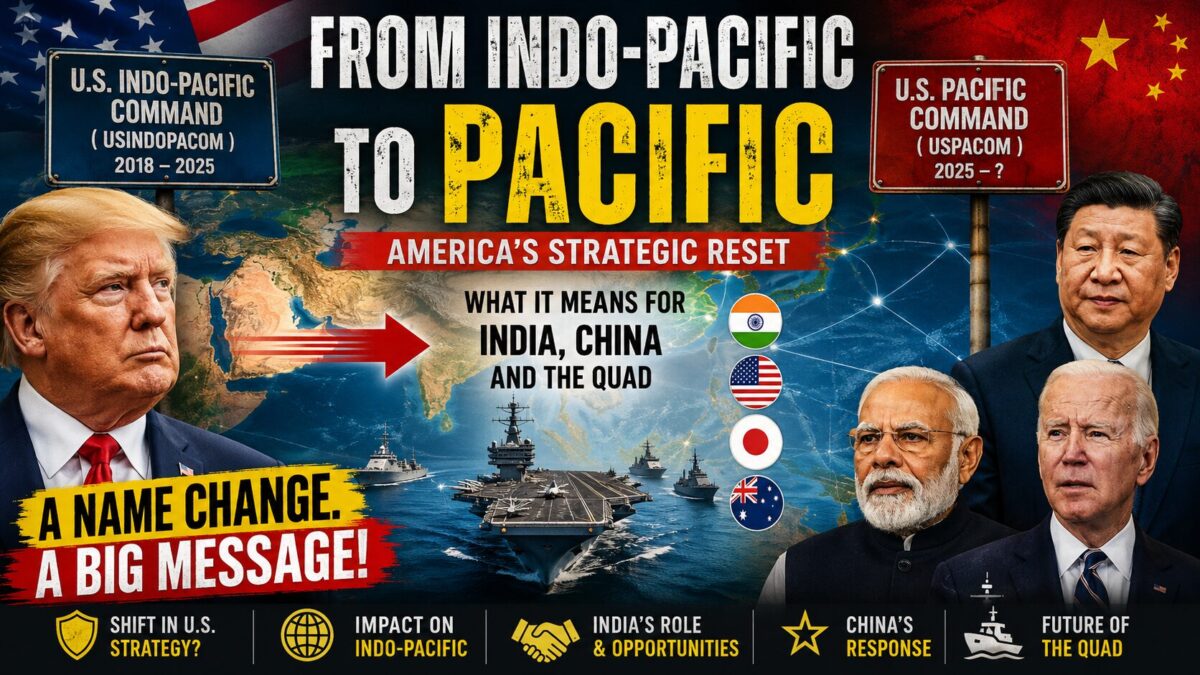
The recent decision by the United States to restore the name U.S. Pacific Command (USPACOM) in place of U.S. Indo-Pacific Command (USINDOPACOM) has therefore attracted considerable attention among strategic analysts. While the change is administrative on paper, it carries broader implications for Washington’s regional messaging and raises questions about whether the United States is recalibrating its approach to Asia.
Is this merely a bureaucratic adjustment, or does it signal a deeper shift in American strategic priorities?
The answer has profound implications for India, China, the Quad, ASEAN, and the evolving security architecture of the world’s most economically dynamic region.
Understanding the Evolution of the Indo-Pacific Concept
The concept of the Indo-Pacific did not originate in Washington.
Japanese Prime Minister Shinzo Abe popularized the idea in his landmark 2007 address, Confluence of the Two Seas, envisioning the Indian and Pacific Oceans as a single strategic theatre.
Subsequently:
- Australia incorporated the concept into its defence policy.
- India embraced it through its Act East Policy and maritime diplomacy.
- The United States officially adopted it in 2018 by renaming USPACOM to USINDOPACOM.
The objective was clear:
- strengthen India-US strategic cooperation
- counterbalance China’s growing maritime influence
- secure global sea lanes
- deepen cooperation among regional democracies
- promote a rules-based international order
The terminology itself acknowledged India’s growing geopolitical significance and reflected Washington’s recognition that the Indian Ocean had become central to global commerce and security.
Why Does a Name Matter?
Military organizations seldom rename commands without strategic reasoning.
The original Pacific Command, established in 1947, has historically overseen one of the world’s largest military theatres, covering nearly half the Earth’s surface and encompassing numerous U.S. allies and partners.
By adding “Indo,” Washington conveyed several messages:
- India had become indispensable to regional security.
- The Indian Ocean and Pacific Ocean constituted one integrated strategic space.
- China would face coordinated balancing efforts.
- The Quad would serve as an important platform for strategic dialogue.
Reverting to the older name inevitably alters those perceptions.
What Could Washington Be Signalling?
Several strategic interpretations emerge.
1. Greater Emphasis on Military Deliverables
Unlike the broader Indo-Pacific vision, which encompasses trade, infrastructure, technology, climate resilience, and supply-chain security, the Pacific Command primarily represents a military command structure.
Recent U.S. initiatives increasingly emphasize narrowly focused security partnerships.
Examples include:
- AUKUS
- U.S.–Japan–South Korea trilateral cooperation
- Expanded defence cooperation with the Philippines
- Increased military exercises around Taiwan
Each has clearly defined military objectives rather than broader geopolitical ambitions.
2. Strategic Flexibility Toward China
Washington continues strategic competition with Beijing while simultaneously maintaining dialogue in areas such as trade, technology, climate, and crisis management.
A less ideologically framed regional construct may provide greater diplomatic flexibility without fundamentally altering U.S. military posture.
However, this interpretation remains debated among scholars.
3. Reprioritisation Rather Than Retreat
The restoration of the Pacific Command should not automatically be interpreted as American disengagement from Asia.
Recent developments suggest otherwise.
The United States has expanded:
- joint naval patrols
- missile defence cooperation
- military interoperability
- intelligence sharing
- logistics agreements
- defence industrial collaboration
with multiple regional partners.
In other words, capabilities continue expanding even if strategic branding evolves.
Implications for India
India occupies a unique position.
Unlike many American allies, India maintains strategic autonomy, engaging simultaneously with:
- the United States
- Russia
- Europe
- Japan
- ASEAN
- the Middle East
New Delhi has consistently described the Indo-Pacific as an inclusive rather than exclusive geopolitical framework.
For India, the Indo-Pacific encompasses:
- maritime security
- disaster relief
- connectivity
- blue economy
- digital cooperation
- resilient supply chains
- infrastructure investment
- climate resilience
Therefore, any perception that Washington increasingly views the region primarily through a military lens could produce subtle differences in strategic expectations.
Nevertheless, India-US defence cooperation remains stronger than at any previous point.
Recent initiatives include:
- foundational defence agreements
- technology cooperation
- intelligence sharing
- joint military exercises
- defence manufacturing partnerships
These suggest that operational cooperation is unlikely to diminish solely because of a nomenclature change.
China’s Perspective
Beijing has long criticized the Indo-Pacific concept.
Chinese policymakers argue that it represents an attempt to contain China’s rise by building a coalition of democracies around its maritime periphery.
From Beijing’s perspective, the return of “Pacific Command” could be interpreted as:
- reduced ideological emphasis on Indo-Pacific coalitions
- greater U.S. focus on traditional military geography
- opportunities to deepen engagement with South Asian countries
However, China is unlikely to conclude that American strategic competition has fundamentally weakened.
U.S. military deployments, alliance strengthening and freedom-of-navigation operations continue across the Western Pacific.
The Future of the Quad
The Quad—comprising India, United States, Japan and Australia—has evolved significantly beyond security.
Its agenda now includes:
- vaccine partnerships
- semiconductor supply chains
- critical technologies
- cyber security
- maritime domain awareness
- disaster response
- clean energy
The organization’s future therefore depends less on the name of an American military command and more on the political commitment of its member states.
ASEAN’s Continuing Importance
One concern surrounding the Indo-Pacific debate has been whether major powers risk marginalising ASEAN.
Southeast Asian nations consistently advocate:
- inclusivity
- dialogue
- strategic balance
- freedom of navigation
- avoidance of bloc politics
Maintaining ASEAN centrality remains essential for regional stability.
The Numbers Behind the Strategy
Several statistics illustrate why the Indo-Pacific remains the world’s strategic centre of gravity:
| Indicator | Significance |
|---|---|
| Around 60% of global GDP | Generated in the Indo-Pacific region |
| Nearly 65% of the world’s population | Lives in the region |
| Majority of global maritime trade | Passes through Indo-Pacific sea lanes |
| Nine of the world’s ten busiest ports | Located in the Indo-Pacific |
| Multiple nuclear powers | China, India, Pakistan, North Korea, Russia and the United States all have strategic interests in the region |
These structural realities ensure that the Indo-Pacific—whatever terminology governments employ—will remain central to twenty-first century geopolitics.
Is This the End of the Indo-Pacific?
Probably not.
Strategic concepts often outlive administrative terminology.
The Indo-Pacific has become deeply embedded within:
- Indian foreign policy
- Japanese security strategy
- Australian defence planning
- European Indo-Pacific strategies
- ASEAN discussions
- academic scholarship
Even if Washington adjusts its institutional nomenclature, the broader geopolitical reality remains unchanged.
Conclusion
The restoration of the Pacific Command should be viewed less as an abandonment of the Indo-Pacific vision and more as a reflection of evolving American strategic priorities. The United States appears intent on sharpening the military focus of its regional command architecture while simultaneously relying on flexible, issue-based coalitions such as AUKUS, trilateral partnerships, and the Quad to pursue wider geopolitical objectives.
For India, the development underscores an enduring truth: New Delhi cannot depend solely on symbolic gestures or institutional labels to define its strategic role. Its influence will continue to derive from sustained economic growth, credible military capabilities, maritime outreach, technological innovation, and diplomatic leadership across the Indian Ocean and the wider Indo-Pacific.
Ultimately, geography has not changed. The Indian and Pacific Oceans remain inseparably linked by commerce, energy flows, and strategic competition. Whether Washington calls its combatant command “Pacific” or “Indo-Pacific,” the region will remain the decisive theatre shaping the balance of power in the twenty-first century. The true measure of policy lies not in the nameplate on a military headquarters, but in the alliances forged, the capabilities deployed, and the strategic commitments honoured over time.