
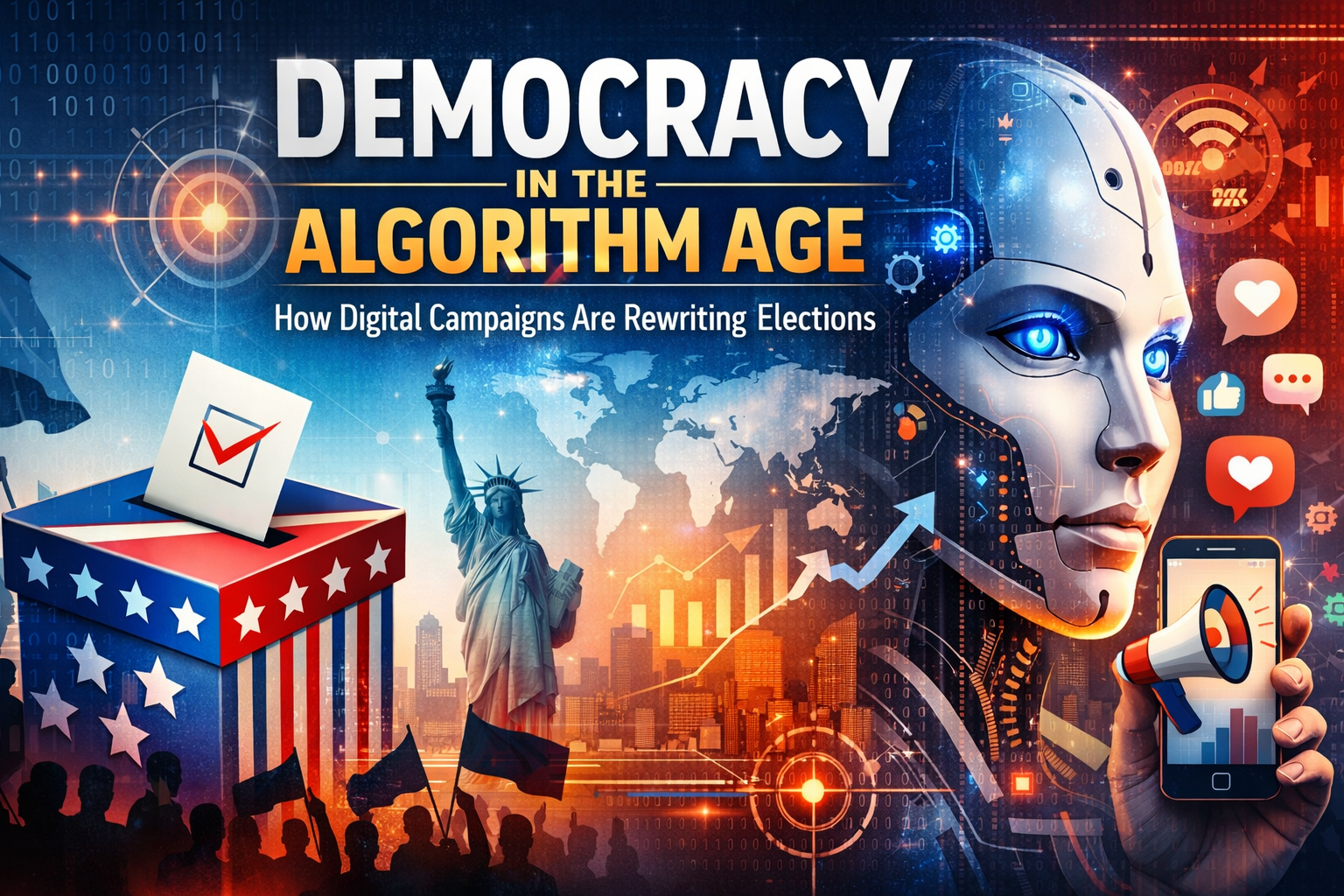
There was a time when elections were won in dusty public grounds, through impassioned speeches and door-to-door persuasion. Today, they are increasingly being shaped in silent digital war rooms, where algorithms, data models, and viral content dictate the rhythm of democracy.
The transformation of electoral campaigning in the digital age is not merely technological—it is structural, psychological, and deeply political. Social media and data science have not just changed how campaigns are run; they have altered how democracy itself functions.
From Mass Messaging to Micro-Persuasion
Traditional campaigning was built on broad narratives aimed at the masses. Political parties crafted messages for entire regions or communities, relying on newspapers, radio, and television to disseminate their ideas. Voters, in turn, consumed these messages passively.
The digital age has shattered this model.
Today’s campaigns are no longer about speaking to everyone—they are about speaking differently to each individual. Through data analytics and behavioral profiling, political actors now segment voters into micro-groups based on age, location, preferences, and even psychological traits. Each group receives a tailored message, carefully designed to resonate with its fears, aspirations, or biases.
This shift from mass communication to micro-persuasion marks one of the most profound changes in modern politics.
Social Media: The New Public Square—or a Fragmented One?
Social media platforms have become the primary battlegrounds of political contestation. They offer unprecedented advantages: direct communication, instant feedback, and the ability to mobilize millions within minutes.
Yet, this new “public square” is not truly public.
Algorithms determine what users see, often reinforcing existing beliefs rather than challenging them. The result is a fragmented information ecosystem—commonly described as “echo chambers”—where citizens are exposed primarily to viewpoints they already agree with.
In such an environment, political discourse risks becoming more polarized, less deliberative, and increasingly driven by emotion rather than reason.
Data Science: Efficiency at the Cost of Transparency?
The integration of data science into electoral campaigns has brought remarkable efficiency. Campaigns can now predict voter behavior, identify swing constituencies, and optimize resource allocation with surgical precision.
But this efficiency comes with a cost.
The use of personal data—often collected without explicit consent—raises serious concerns about privacy and ethical boundaries. When political messaging is tailored to individual psychological profiles, the line between persuasion and manipulation becomes dangerously thin.
The infamous data misuse scandals of recent years have already shown how vulnerable democratic systems can be in the face of unregulated data practices. Yet, regulatory frameworks remain inadequate, struggling to keep pace with technological innovation.
The Rise of AI and the Crisis of Authenticity
If social media and data analytics were the first wave of digital campaigning, artificial intelligence represents the next frontier—and perhaps the most disruptive one.
AI tools can now generate speeches, create hyper-realistic videos, and simulate public engagement at scale. Deepfakes and synthetic media blur the line between reality and fabrication, making it increasingly difficult for voters to distinguish truth from falsehood.
In such a landscape, authenticity—a cornerstone of democratic politics—becomes a casualty.
When voters cannot trust what they see or hear, the very foundation of informed decision-making is undermined.
Democracy at a Crossroads
The digital transformation of election campaigns is not inherently negative. It has democratized access to political communication, empowered smaller parties, and increased citizen engagement. It has made politics more immediate, interactive, and accessible.
But it has also introduced new vulnerabilities—misinformation, polarization, surveillance, and manipulation.
Democracy today stands at a crossroads. The same technologies that enable greater participation can also be used to distort public opinion. The same data that helps understand voters can also be weaponized to exploit them.
The Way Forward
The challenge before modern democracies is not to resist technological change but to govern it wisely.
This requires:
- Stronger data protection laws
- Transparent regulation of digital political advertising
- Accountability mechanisms for social media platforms
- Public awareness about misinformation and digital literacy
Above all, it requires a renewed commitment to the core principles of democracy—transparency, fairness, and informed consent.
Conclusion
Elections are no longer fought only on the streets or in legislative halls; they are fought in timelines, data centers, and algorithmic networks. The tools have changed, but the stakes remain the same.
If democracy is to survive and thrive in the algorithm age, it must adapt without losing its soul.
Because in the end, the question is not whether technology will shape politics—it already does. The real question is whether politics can still serve the people in a world increasingly shaped by machines.
