
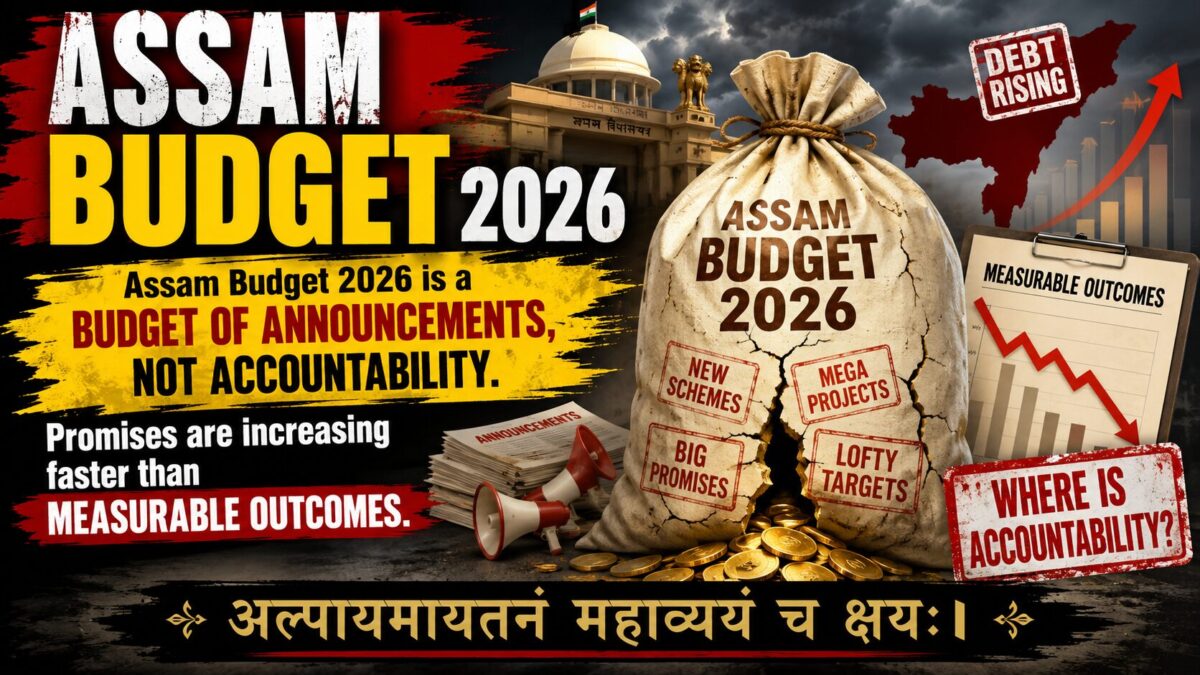
The Assam Budget 2026–27 is a budget that excels in making promises but falls short of demonstrating accountability. While it presents an impressive catalogue of new schemes, welfare initiatives and ambitious infrastructure announcements, it remains conspicuously silent on one fundamental question: what measurable outcomes have previous budgets actually delivered? A budget is not merely an annual exercise in announcing fresh commitments; it is a statement of fiscal priorities, economic vision and governmental accountability. By focusing more on expanding announcements than evaluating implementation, the government has once again chosen political optics over institutional transparency. In an economy grappling with unemployment, uneven industrialisation, rising fiscal commitments and widening development disparities, Assam needed a budget rooted in structural reforms and evidence-based governance. Instead, it has received a document that appears more intent on shaping headlines than answering hard questions about jobs, investment, productivity and the long-term sustainability of the state’s finances.
In Book 2, Chapter 7, Chanakya explicitly defines the crime of wasting state wealth on personal or non-productive avenues. He calls the unjustified depletion of revenue “Kṣaya” (Erosion/Decay) and labels it a severe administrative failure:
अल्पायमायतनं महाव्ययं च क्षयः।
Alpāyam\ āyatanaṁ\ mahāvyayaṁ\ ca\ kṣayaḥ.
Translation: “Where the revenue generated is small, and the expenditure is large and unjustified, it is called Kṣaya (the erosion/decay of the state’s foundation).”
He further elaborates that officials or rulers who consume the state’s wealth on luxury or whims are “eating the livelihoods of the subjects”:
…कोशं भक्षयन्ति। (…kośaṁ bhakṣayanti) — “…they are devouring the treasury.”
Key Criticisms of the Assam Budget 2026–27
1. The Debt Trap: The Illusion of Surplus Dissected
The government has claimed a structural financial victory, but both the budget math and the latest CAG audit flags reveal an economy on life support, fueled by unsustainable borrowing.
- The 20% Debt Dependency: Public debt receipts are pegged at exactly ₹30,000 crore, representing an alarming 19.76% of total inflows into the Consolidated Fund. The state is borrowing nearly one-fifth of its entire annual lifecycle just to keep the lights on.
- The Deceptive Surplus: The government trumpets a “transaction surplus” of ₹3,225 crore. However, when forced to absorb the massive unbacked opening deficit of ₹3,644.26 crore, the year collapses into a net budgetary deficit of ₹419.26 crore.
- Zero Shock-Absorptive Capacity: Total expenditure scales to ₹2,85,084.45 crore. A closing safety buffer of ₹419.26 crore means a margin of error of just 0.15%. As the CAG explicitly warns, such volatile fiscal paths leave “little room for fiscal consolidation,” meaning a single severe monsoon or delay in central flows will plunge the state into structural insolvency.
- FRBM Redlining: The budget runs directly against the wall, pegging the fiscal deficit at the maximum statutory ceiling of 3% of GSDP.
- The CAG Warning on Off-Budget Liabilities: While the Treasury claims liabilities are legally within bounds, the latest CAG Report exposes severe risks, noting that outstanding debt figures must be analyzed “in the context of growing outstanding off-budget borrowings and contingent liabilities through guarantees” that are deliberately kept off the primary balance sheet.
2. Weak Internal Engines & Evaporating Revenue Effort
The budget lays bare a complete failure to build internal industrial strength, exposing an economy overly reliant on central tax allocations and declining autonomous performance.
- The Centralization Paradigm: Assam’s own internal tax collection engine yields only ₹36,000.10 crore (23.71%). Conversely, it relies on the Share of Central Taxes for ₹47,905.24 crore (31.55%).
- The 50% Dependency Benchmark: When combining the Share of Central Taxes (31.55%) with Centrally Sponsored Schemes (16.24%) and Finance Commission Grants (2.13%), Assam is dependent on the Union government for 49.92% (half) of its total fund lifecycle.
- The CAG’s Verdict on Weakening Revenue Effort: The latest CAG data shows a structural decline, noting that “Revenue receipts as a percentage of GSDP dropped from 19.10% to 15.06%,” a metric pointing directly to weakening internal revenue efforts and a failure to broaden the local industrial tax base.
3. The Populism Shift: Cannibalizing the Capital Future
Rather than financing growth, debt is being explicitly deployed to bankroll political consumption, causing severe imbalances in physical asset and human capital development.
- The Unchecked Rise of Subsidies: The CAG report highlights a staggering 124.63% spike in subsidy expenditure in a single year, driven heavily by power sectors. This structural bleed directly matches the current budget’s massive welfare transfer line items totaling over ₹6,000 crore.
- The Admission of Capital Shortfalls: In Paragraph 43, the government admits it cannot sustain its high-profile infrastructure incentive programs. The physical distribution of the Dr. Banikanta Kakati Merit Award (scooters) is being completely shut down after this session, with funds diverted into the regular Nijut Moina and Nijut Babu cash pipelines. This confirms the opposition’s primary charge: the government is running out of capital space and must cannibalize its student merit initiatives to support recurring outlays.
- Unrealistic Per Capita Metrics: While the budget points to nominal per capita income hitting ₹1,85,429, it purposefully obfuscates double-digit inflationary pressures on food and building materials. As the CAG notes, committed expenditures continue to compress standard discretionary and developmental allocations.
4. The KCC NPA Stagnation: Bureaucratic Apathy for Farmers
- Credit Flow Strulation: The budget explicitly reports that Non-Performing Assets (NPAs) under the Kisan Credit Card (KCC) scheme have hit ₹1,935 crore.
- 3.38 Lakh Farmers Blacklisted: This massive credit blockage locks 3.38 lakh farming families entirely out of institutional financial support. Instead of providing immediate interest subventions, crop insulation metrics, or localized capital interventions, the budget relies on a vague phrase: “working with banks to formulate an action plan.”
5. Regressive Taxes & “Seuj Shulk” Inflation
- The assault on the Lower-Middle Class: While the government offers minor, politically timed adjustments in tea grower brackets and piped gas VAT, it has introduced a highly regressive “Seuj Shulk” (Green Tax).
- Fuelling Cost of Living: Imposed on stone-crushing mills, brick kilns, commercial groundwater extraction, and the transfer of ownership of used/old vehicles, this tax will act as an immediate inflationary catalyst. It will directly raise logistics, construction, and basic real estate costs across the state.
6. Project Illusions and the CAG Accountability Deficit
- The Dibrugarh Political Mirage: The expansion of the “Dibrugarh Capital Region” with an outlay of ₹500 crore over five years is a clear political distraction. Spreading thin capital assets over separate regional centers when primary systems in Guwahati remain underfunded guarantees incomplete infrastructure.
- Chronic Underutilization and Financial Indiscipline: The Treasury’s bold spending declarations stand completely exposed by the CAG’s strict review of budget marksmanship:
- The CAG caught the state running massive savings/underutilization of up to 13.71% (over ₹23,126 crore) in its overall provisions, proving the government frequently tables inflated, unrealistic budgets it lacks the capacity to execute.
- Worse, the CAG flagged severe accounting irregularities, including ₹509.59 crore spent completely without legislative budget provisions under public debt heads.
- The Transparency Black Hole: A staggering ₹23,240 crore in Utilisation Certificates (UCs) remains completely unsubmitted. The state is borrowing billions while failing to account for where past developmental funds actually went.
Note:
- “The CAG has confirmed our worst fears: this government is running a transparency black hole with over ₹23,000 crore in missing Utilisation Certificates. They want the house to vote for ₹30,000 crore in new public debt, when they haven’t even accounted for where the old money went!”
- “This is an admission of failure in black and white. They are stopping the student scooter scheme after this year because their debt-fueled economy is hitting a wall. They are cannibalizing the capital future of our youth to balance their broken balance sheet.”
- “According to the CAG, Assam’s internal revenue effort has dropped from 19% to 15% of GSDP. This budget confirms we are no longer a self-reliant state; we are a state completely reliant on central hand-outs, borrowing ₹30,000 crore just to mask our structural deficits.”