
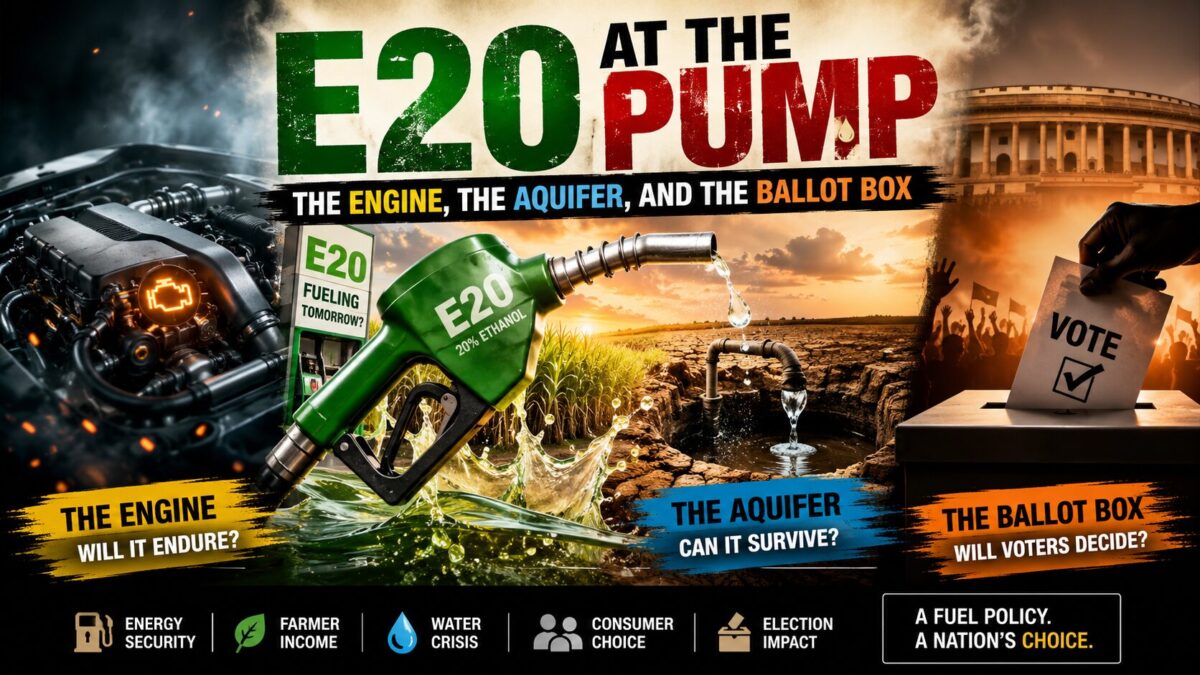
A data-driven examination of India’s ethanol-blending programme, its costs to vehicles and water, and the politics that keep it moving
I. Introduction: A Fuel That Became a Referendum
In 2026, a routine visit to an Indian petrol pump has become an occasion for debate. E20 — petrol blended with 20 percent ethanol — is now sold almost everywhere in the country, five years ahead of the government’s original 2030 target. For policymakers, this is a triumph of planning: ethanol blending rose from under 1.5 percent in 2013-14 to 20 percent nationally by 2025-26. For a substantial share of the driving public, however, the rollout has felt less like a triumph and more like an imposition — arriving in showrooms and fuel stations well before most owners understood what it would mean for the vehicles they already possessed.
This article asks three questions with as much empirical rigour as the available evidence allows. First, does E20 actually damage engines, and is it safe for the vehicles already on Indian roads? Second, what does ethanol production really cost in water, India’s most politically sensitive natural resource? Third, why has a fuel-blending programme become entangled with electoral politics, farm income policy, and even the Supreme Court — and what would a more defensible policy look like?
II. Does E20 Damage Engines? What the Evidence Actually Shows
The honest answer, based on the government’s own testing agencies, is: it’s complicated, and the complication has been under-communicated.
The metals are fine. The rubber is not.
The Automotive Research Association of India (ARAI) — the very body that certified E20 for national rollout — has conducted at least two rounds of testing relevant to this question. An earlier 2021 materials study immersed eight metals, six elastomers (rubber compounds), and four plastics commonly used in fuel systems in both E10 and E20 fuel under laboratory conditions. The result was consistent across both rounds of testing: metal components showed no meaningful increase in corrosion, but <cite index=”4-1″>certain rubber and plastic materials showed greater deterioration when compared with E10 fuel under laboratory conditions</cite>, with specific materials including <cite index=”4-1″>NBR-PVC blends, Epichlorohydrin, and the plastic PA66 recording greater changes in tensile strength and volume</cite>.
A more recent — and until mid-2026, unpublished — ARAI report, cited by the Times of India and corroborated by multiple outlets, extended this finding to whole-vehicle durability testing. It found that <cite index=”1-1″>E20 petrol may deteriorate rubber fuel-system components in vehicles originally designed for E10 fuel, with the affected parts including hoses, gaskets, seals and O-rings</cite>, and it recommended that these parts be replaced in E10-compliant vehicles that continue running on E20. Encouragingly, the same testing programme found that <cite index=”2-1″>across all vehicles tested, E20 fuel had no adverse impact on metallic components, tailpipe emissions remained within legislative limits, and startability and drivability were rated acceptable</cite>. Engine durability runs — <cite index=”1-1″>400 to 806 hours</cite> in duration — did not, in most cases, produce catastrophic failure.
The practical implication is nuanced but important: E20 is not the engine-destroying agent that some viral social media claims suggest, but it is also not inert for every vehicle on Indian roads. The realistic risk profile is degradation of soft components over time — leading to fuel leaks, hardened seals, or clogged systems as a maintenance issue — rather than sudden engine seizure.
The mileage penalty is real and measurable
Where the evidence is unambiguous is fuel efficiency. NITI Aayog’s own 2021 roadmap for ethanol blending stated that <cite index=”3-1″>fuel economy decreased up to 6 percent, depending on the vehicle type, in vehicle-level studies</cite>. The 2026 ARAI durability tests corroborated this, finding <cite index=”2-1″>fuel consumption on E20 rose between 2 and 6 percent compared to E10, with the increase varying by vehicle</cite>. Independent automotive experts have argued the real-world number is worse than official figures suggest: one industry commentator cited in a policy panel discussion described <cite index=”23-1″>real-world mileage drops of 10-12 percent for two-wheelers and 8-10 percent for cars under 1500cc, with larger engines less affected</cite>. Since ethanol carries roughly 30 percent less energy per litre than petrol, some efficiency loss is a matter of chemistry, not conspiracy — but the magnitude, and who absorbs the cost of it, is where the argument lies.
Is E20 appropriate for existing (older) vehicles?
This is the crux of the consumer complaint, and the government’s own planning documents anticipated it clearly. The 2021 NITI Aayog roadmap explicitly distinguished between material compatibility and engine-tuning compatibility: it <cite index=”1-1″>stated that rubber and plastic components in existing petrol vehicles were compatible with E10, but E20 would require vehicles to become both material-compatible and engine-tuned for E20 use</cite>, and it <cite index=”1-1″>recommended E20 material-compliant vehicles from April 2023 and E20 engine-compatible vehicles from April 2025</cite>, with compatibility to be <cite index=”1-1″>defined by the vehicle manufacturer and displayed through a visible sticker</cite>.
In other words, the government’s own roadmap anticipated a multi-year transition period during which older, non-E20-compliant vehicles would remain on the road alongside new E20-ready ones — and recommended a labelling mechanism to help consumers navigate it. That labelling infrastructure has been, at best, inconsistently implemented, while the fuel itself was rolled out nationally regardless of vehicle stock turnover. India has an estimated 30 crore (300 million) vehicles that predate full E20 compatibility, according to figures cited in opposition and legal challenges to the policy — a scale that makes “a maintenance issue” for each individual owner into a macro-level policy gap.
Automakers, for their part, have largely stood behind the fuel: manufacturers <cite index=”1-1″>including Maruti Suzuki, Hero MotoCorp and Toyota Kirloskar Motor said they had not found evidence of ethanol-related vehicle damage during service experience</cite>, and continue to honour warranties. The most defensible synthesis of the evidence is this: E20 is unlikely to cause dramatic engine failure in most well-maintained vehicles, but it does measurably shorten the service life of rubber and plastic fuel-system components not originally designed for it, and it does impose a real, non-trivial fuel-economy penalty — costs that fall disproportionately on owners of older cars and two-wheelers who were given little advance notice or choice.
III. The Hidden Cost: How Much Water Does Ethanol Really Drink?
If engine wear is the consumer-facing controversy, water is the ecological one — and it is arguably the more serious long-term concern for a country where roughly 80 percent of groundwater extraction already goes to agriculture.
The headline number, and why it’s contested
A widely circulated figure holds that producing a litre of ethanol can consume over 10,000 litres of water. This number is real, but it applies specifically to rice-based ethanol, not the programme as a whole. According to India’s food secretary, cited in reporting on the issue, <cite index=”5-1″>producing one litre of ethanol from rice requires roughly 10,790 litres of water, with most of this consumed during cultivation rather than processing, since growing one kilogram of rice typically needs between 3,000 and 5,000 litres of water and roughly 2.5 to 3 kilograms of rice are required per litre of ethanol</cite>. This is a serious concern given that the <cite index=”5-1″>government allocated 52 lakh tonnes of rice for ethanol production in 2024–25 and is targeting 90 lakh tonnes in 2025–26</cite>, partly by <cite index=”5-1″>reducing the share of broken rice distributed through the public distribution system from 25 percent to 10 percent</cite> to free up grain for distilleries — a diversion with direct implications for food security.
Sugarcane, the dominant feedstock, tells a more contested story. Multiple reports place its water footprint <cite index=”5-1″>at around 3,630 litres per litre of ethanol</cite>, with NITI Aayog’s own roadmap estimating <cite index=”6-1″>that producing one kilogram of sugar from sugarcane requires between 1,600 and 2,100 litres of water, implying roughly 3,000 litres per litre of ethanol from sugar</cite>. An independent global water-footprint study puts the figure for Indian sugarcane ethanol at a comparable <cite index=”10-1″>2,995 litres per litre</cite>, versus 2,450 in Brazil and 2,775 in the United States — suggesting Indian sugarcane cultivation is somewhat less water-efficient than its major competitors, though in the same broad range.
However, an industry-funded counter-study has pushed back hard on this consensus. A 2026 report from the Indian Sugar & Bio-energy Manufacturers Association (ISMA), conducted with ICAR institutes, argued that <cite index=”7-1″>producing one kilogram of sugarcane requires about 173 litres of water under conventional farming, and as little as 114 litres with drip irrigation — far less than rice or wheat, which can require up to 2,244 litres per kilogram, or maize, which needs over 1,600 litres</cite>. If accurate, this would reposition sugarcane as one of the more water-efficient biomass crops per unit of output, rather than the water guzzler it is popularly portrayed as being. It is worth noting plainly that this study was co-authored by the industry body with the most direct financial stake in defending sugarcane-based ethanol, which does not make its data wrong, but does warrant independent verification before it is treated as the final word.
There is a genuine methodological question underlying this dispute, separate from advocacy: whether the water used to grow sugarcane should be charged entirely to ethanol, given that ethanol is typically produced from molasses, a by-product of sugar milling rather than the primary crop output. As one water-policy analysis notes, when ethanol is produced from molasses that is a by-product of sugar manufacturing, <cite index=”8-1″>the water used to grow that sugarcane has already been “spent” in producing the sugar, and whether to then allocate all of that agricultural water footprint to the ethanol or split it between the sugar and the molasses is a methodological choice that different studies make differently</cite>. Direct processing water in the distillery itself is comparatively negligible — <cite index=”8-1″>only about 3.5 litres per litre of ethanol produced</cite> — meaning the entire debate is really about how to account for upstream agricultural water, not about factory water use.
Geography matters more than the national average
Whatever the “correct” per-litre number, the more urgent problem may be geographic mismatch. India’s <cite index=”5-1″>ethanol production capacity currently stands at 1,822 crore litres, with a large share concentrated in water-stressed regions — Maharashtra alone accounts for 396 crore litres of capacity, even as areas like Vidarbha and Marathwada face acute drinking water shortages, while ethanol plants in Uttar Pradesh and Karnataka draw from groundwater reserves already classified as critically depleted</cite>. A national average water-footprint figure, however it is calculated, obscures the fact that ethanol expansion is concentrated precisely in the states least able to absorb additional agricultural water demand. Ethanol distilleries also generate vinasse, a nutrient-rich wastewater that, cited experts warn, <cite index=”9-1″>can pollute surface and groundwater if not treated properly</cite>.
IV. The Political Economy: Why E20 Is Not Just a Fuel Policy
It would be naive to discuss E20 purely as an engineering or hydrological question. The programme sits at the intersection of energy security, farm politics, and electoral calculation, and understanding this is essential to understanding why the government has been reluctant to slow down or offer consumer choice.
The economic case the government makes
The official justification rests on four pillars: reduced crude-import dependence, farmer income support, foreign-exchange savings, and emissions reduction. The claimed numbers are substantial. Government-linked figures for the period from ESY 2014-15 to July 2025 cite <cite index=”16-1″>foreign exchange savings of more than Rs 1,44,087 crore, crude oil substitution of about 245 lakh metric tonnes, and CO2 emission reduction of approximately 736 lakh metric tonnes — described as equivalent to planting 30 crore trees</cite>. At current blending levels, the programme is projected to direct <cite index=”16-1″>around Rs 40,000 crore a year to farmers and roughly Rs 43,000 crore in annual forex savings</cite>. Separately, industry figures cite <cite index=”20-1″>more than Rs 1.18 lakh crore transferred to over five crore sugarcane farmers</cite> since the programme’s expansion, alongside claims that blending has helped <cite index=”20-1″>stabilise sugarcane prices, ensure timely farmer payments, and manage excess sugar inventories</cite>.
The farm-politics dimension is explicit, not incidental
Unlike many technical fuel-policy debates, the sugarcane connection has been stated openly, including in court. When a Public Interest Litigation challenged the mandatory E20 rollout without a pure-petrol alternative, <cite index=”19-1″>India’s Attorney General told the Supreme Court that the government’s move was well considered and would also benefit farmers who grow sugarcane, the main ingredient of ethanol</cite>, and the Supreme Court ultimately <cite index=”17-1″>declined to entertain the plea, considering the central government’s claim that E20 fuel benefitted sugarcane farmers</cite>. The Attorney General’s framing during the hearing was notably blunt, reportedly telling the court that <cite index=”21-1″>sugarcane farmers are benefitting from this policy</cite> in response to the petitioner’s objections. Separately, senior political leaders have tied the ethanol programme directly to rural income policy: at a public event, the Union Home Minister stated that the <cite index=”22-1″>programme to blend ethanol in petrol and diesel was revived after the BJP-led NDA came to power, with blending rising from 1.18 percent in 2014 to 10 percent, partly by allowing ethanol production from sugarcane, maize and paddy held by the Food Corporation of India</cite>, explicitly framing it as a mechanism to enhance farmer income.
Public opinion has not followed the policy
Despite this sustained political commitment, public sentiment — including among the government’s own voter base — remains sceptical. A C-Voter survey found that <cite index=”13-1″>more than half of NDA supporters, 52.5 percent, said they would not prefer using E20 petrol in their vehicles, while only 18.1 percent expressed willingness to switch</cite>, and <cite index=”13-1″>overall 55.1 percent of respondents opposed using E20 petrol compared with just 17.1 percent who supported it</cite>. Tellingly, when asked to identify the government’s real motive, <cite index=”13-1″>only 27.5 percent cited reducing crude oil imports as the primary driver, while 21.3 percent pointed to support for sugarcane farmers</cite> — suggesting that a substantial share of the public perceives the programme as farm politics wearing the clothing of energy policy, whether or not that perception is entirely fair to the programme’s genuine energy-security rationale.
The government has resisted the obvious compromise
The most frequently proposed remedy — retaining E10 or pure petrol as parallel options at fuel stations, at least until vehicle stock turns over — has been explicitly rejected by the Ministry of Petroleum. The Ministry has argued that <cite index=”24-1″>the suggestion that every petrol pump should stock pure petrol, E10 and E20 simultaneously ignores the realities of India’s fuel distribution network</cite>, citing the logistical burden of running parallel supply chains across <cite index=”25-1″>a network of refineries, depots, pipelines and over one lakh retail outlets</cite>. The Ministry also points to <cite index=”24-1″>roughly Rs 1 lakh crore per year in ethanol-production investment financed by public sector banks</cite> — investment that a rollback or dilution of the mandate would strand. This is a legitimate logistical and financial constraint, but it is also, unavoidably, a political one: reversing course would mean unwinding financial commitments made to a powerful agro-industrial constituency in an election-sensitive rural economy.
It is worth noting, for context, that India is not alone in mandating high blends without full consumer choice. Brazil, often cited by the ethanol industry as a success story, blends E27 as its standard fuel nationally and is <cite index=”20-1″>targeting 30 percent by 2030</cite>, with little of the controversy seen in India — though Brazil’s vehicle fleet has been engineered around high ethanol content for far longer, and its “flex-fuel” vehicles, capable of running on any ethanol-petrol ratio up to pure ethanol, are the market norm rather than the exception. The United Kingdom, by contrast, when introducing the much milder E10 blend, conducted a formal multi-year consumer consultation and mandated that <cite index=”26-1″>fuel pump and vehicle labelling requirements be put in place specifically to protect consumers who might unknowingly use an incompatible fuel</cite> — a regulatory step India’s own 2021 roadmap recommended but has not consistently enforced at the retail level.
V. Recommendations: What the Government Should Do
Drawing on the evidence above, five concrete, non-partisan policy interventions would meaningfully address the legitimate consumer and environmental concerns without abandoning the programme’s genuine energy-security and rural-income objectives:
1. Publish the ARAI compatibility findings in full, immediately. The core public-trust problem is that a government testing agency’s own findings on rubber and plastic degradation remained unpublished until leaked to the press. Full, proactive disclosure — including vehicle-specific durability data — would do more to restore confidence than any amount of reassurance from ministries or industry bodies.
2. Implement the sticker-labelling system the 2021 roadmap already recommended. NITI Aayog’s own plan called for visible fuel-compatibility labelling on vehicles and at the pump. Five years later, this remains largely unimplemented. This is a low-cost, high-trust intervention that the government has already committed to on paper.
3. Create a subsidised fuel-system retrofit or replacement scheme for pre-2023 vehicles. If ARAI’s own testing shows that E10-compliant vehicles need rubber and plastic component replacement to safely run on E20 long-term, the government — having mandated the fuel switch — bears some responsibility for underwriting the transition cost for existing owners, particularly for lower-income two-wheeler users who make up the bulk of India’s vehicle fleet.
4. Commission an independent, non-industry-funded water audit of ethanol feedstocks, mapped by region. Given the significant gap between the ISMA-ICAR sugarcane figures and other cited estimates, and given that ethanol capacity is concentrated in water-stressed Maharashtra, Uttar Pradesh, and Karnataka, an independent lifecycle water audit — ideally conducted by an academic or multilateral body without a financial stake in the outcome — should precede any further increase in blending targets. This audit should include mandatory groundwater-stress mapping before new distillery capacity is approved in critically depleted districts, and stricter treatment norms for vinasse discharge.
5. Reconsider the pace, not necessarily the destination, of blending beyond E20. The Bureau of Indian Standards has already notified specifications for E22 through E30. Before those blends are mandated nationally, the government should commit to completing vehicle-fleet compatibility studies, publishing them, and allowing a genuine transition window — rather than repeating the compressed timeline that made E20’s own rollout contentious.
None of this requires abandoning ethanol blending as a strategic goal. The energy-security and farm-income arguments for the programme are real and well documented. But a policy this consequential — touching 300 million vehicles and a food-water-energy nexus already under strain — deserves the transparency, consumer choice, and independent scrutiny that have so far been in short supply.
VI. Conclusion
E20 is neither the engine-killer of social media alarm nor the entirely benign fuel of official messaging. It is, more precisely, a policy whose environmental and economic logic is sound in aggregate but whose costs — in wearing rubber seals, in reduced mileage, in strained aquifers, and in eroded public trust — have been distributed unevenly and communicated poorly. The science is measurable; the politics, so far, has moved faster than the evidence could keep up with it.
This article draws on Automotive Research Association of India (ARAI) testing data, NITI Aayog’s 2021 Roadmap for Ethanol Blending in India, Supreme Court proceedings, Ministry of Petroleum and Natural Gas statements, C-Voter survey data, and independent water-footprint research, current as of July 2026.