
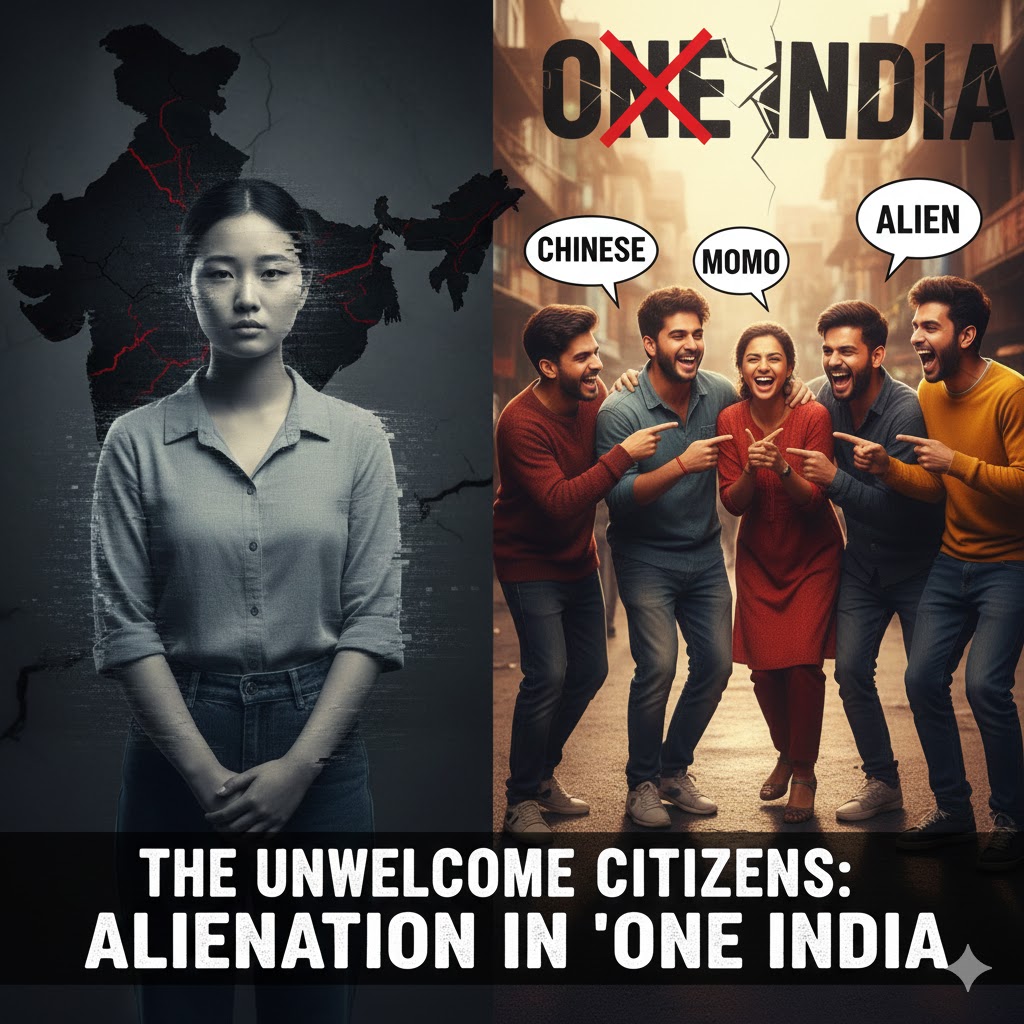
The recent killing of Anjel Chakma, a 24-year-old MBA student from Tripura, has sent shockwaves through Northeast India, reigniting a painful conversation about racial violence and the systemic exclusion of the region from the “One India” narrative.
This tragedy is not an isolated incident; it is a manifestation of deep-seated prejudices that persist despite decades of “Act East” rhetoric.
Why “One India” Often Excludes the Northeast
The “One India” ideology promotes a vision of a unified national identity. However, for many in the Northeast, this vision feels like a “mainland” construct that fails to accommodate their unique ethnic, linguistic, and cultural realities.
1. The “Physicality” of Citizenship
The most immediate form of exclusion is racial. Because many Northeast people have East and Southeast Asian facial features, they are often perceived as “foreigners” or “aliens” within their own country. The slur “Chinese” used against Anjel Chakma is a common tool of “othering,” stripping an Indian citizen of their national identity based on their appearance.
2. Historical and Geographic Distance
The Northeast was integrated into the Indian Union under complex historical circumstances. The “Inner Line” regulations of the colonial era and the post-independence focus on the region as a “security frontier” rather than a cultural heartland have created a mental barrier. Mainland India’s history books often neglect the rich legacies of Northeastern kingdoms (like the Ahom or Tripuri dynasties), focusing instead on North Indian and Mughal history.
3. The “Standardization” of Culture
The “One India” idea often inadvertently pushes a standardized version of “Indianness”—usually centered on Indo-Aryan languages (like Hindi), specific dietary habits, and mainstream religious festivals.
- Culinary Racism: The consumption of fermented foods or meats that differ from mainland staples is often met with disgust or mockery.
- Linguistic Alienation: Students who speak their native tongues or English are often pressured to assimilate into the Hindi-speaking mainstream to be considered “true Indians.”
4. Legal and Institutional Gaps
The demand for a standalone Anti-Racial Violence Law (following the recommendations of the M.P. Bezbaruah Committee after the 2014 killing of Nido Tania) remains unfulfilled. The absence of specific legal protections for racial hate crimes suggests that the state does not yet view “internal racism” with the same gravity as other forms of communal violence.
The Resilience of the Northeast Voice
The death of Anjel Chakma has united the “Seven Sisters” in a demand for dignity. In view of these incidents, we demand:
- Strict Enforcement: Charging the perpetrators under murder and hate crime sections of the Bharatiya Nyaya Sanhita.
- Safety Infrastructure: Establishing dedicated helplines and special police units for Northeastern residents in major Indian cities.
- Educational Reform: Including Northeastern history and culture in the national curriculum to dismantle ignorance at the root.
The death of Anjel Chakma must be the final wake-up call for a nation that prides itself on unity. We cannot claim to be ‘One India’ while our brothers and sisters from the Northeast are forced to live as ‘foreigners’ within their own borders. True integration requires more than just infrastructure projects and political slogans; it requires a legislative shield against racial hate and a heart that recognizes diversity as a strength, not a suspicion. Justice for Anjel is not just about punishing his killers—it is about dismantling the prejudice that allowed them to feel justified in their violence.