
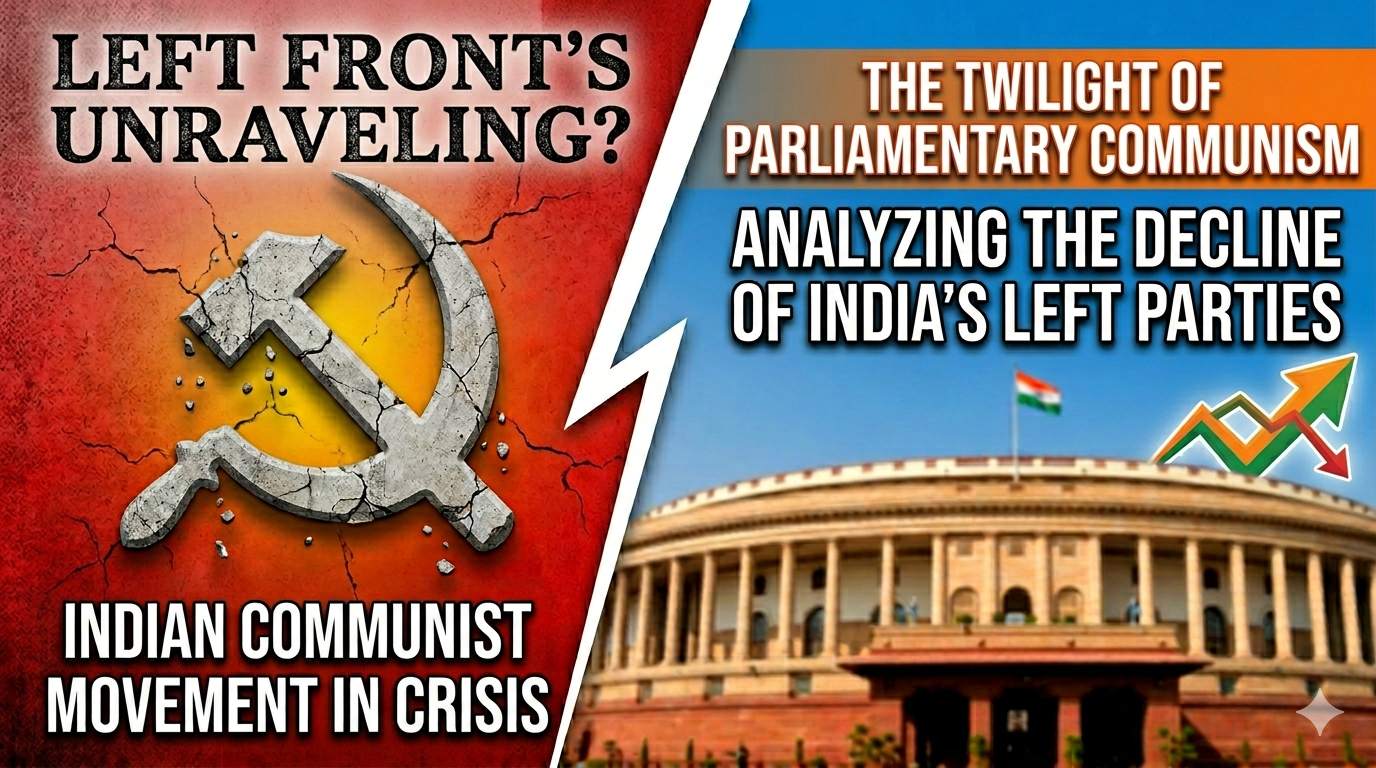
Introduction: An Epochal Shift in Indian Politics
For more than half a century, the crimson flag of parliamentary communism was a defining fixture of the Indian political landscape. From the paddy fields of West Bengal to the backwaters of Kerala and the tribal belts of Tripura, left-wing parties—primarily the Communist Party of India (Marxist) [CPI(M)] and the Communist Party of India (CPI)—commanded the destiny of more than 100 million people.
However, contemporary Indian politics is witnessing what appears to be the twilight of this ideological bloc. Following the electoral defeat of the CPI(M)-led Left Democratic Front (LDF) in Kerala after a decade in power, India no longer features a single communist-led state government. This milestone highlights a stark trajectory of decline, shifting the Left from kingmakers in New Delhi to a peripheral force struggling for its electoral survival.
The Scale of the Collapse: From Kingmakers to the Periphery
To understand the decline of Left parties in India, one must look at the sheer scale of their historical footprint compared to their present reality:
- The Peaks of Power: In West Bengal, the Left Front governed uninterruptedly from 1977 to 2011, establishing one of the longest-running democratically elected communist administrations in global history. Tripura saw a parallel 25-year unbroken stretch of Left rule before falling to the Bharatiya Janata Party (BJP) in 2018.
- The Delhi Leverage: In 1996, Jyoti Basu, the legendary CPI(M) Chief Minister of West Bengal, was offered the Prime Ministership of India by a coalition of secular parties. Though the party famously rejected the offer—a move Basu later labeled a “historic blunder”—the Left retained immense national leverage. As late as 2008, the Left parties wielded 62 seats in parliament, utilizing their leverage to challenge Prime Minister Manmohan Singh’s government over the Indo-US civil nuclear deal.
- The Current Retrenchment: Today, the CPI(M)’s national popular vote share has plummeted from its peak of over 6% in the 1980s to below 2%. In West Bengal, they have been reduced to a single seat in the 294-member assembly, commanding a mere 4% vote share. Nationally, the Left survives on life support—relying on regional alliances in Tamil Nadu, maintaining localized grassroots energy through the CPI(Marxist-Leninist) in Bihar, or depending on ideological student wings in universities.
Structural Realities: The Trap of a “Federal Political Economy”
Political scientists point out a structural paradox that uniquely constrained Indian communism. Unlike their counterparts in China or Vietnam, India’s communist parties operated within a democratic, federal capitalist economy. They did not control the sovereign levers of macroeconomics; instead, they managed provincial administrations with restricted financial and administrative powers.
To sustain state governments, they were forced to adapt to the rules of the market. In West Bengal, this contradiction culminated in an electoral disaster. The party that originally consolidated its power through radical land reforms found itself forcibly dispossessing peasants to clear space for corporate industrialization, triggering a severe populist backlash.
In Kerala, the celebrated “Kerala Model”—characterized by high literacy, decentralization, and robust public healthcare—strained against fiscal realities. Deprived of industrial depth and overly reliant on volatile foreign remittances from the Gulf, the state faced severe youth unemployment. This eventually pushed the Kerala Left to formally endorse private investment, public-private partnerships, and private universities in a 2022 policy document—aligning with the exact social-democratic and neo-liberal structures they historically denounced.
The Changing Political Language: Identity Over Class
The overarching reason for the decline of Left parties in India lies in the shifting vocabulary of the Indian voter. The classical Marxist language of class struggle, collective mobilization, and agrarian solidarity has been largely displaced by:
- The Rise of Ethno-Nationalism: The ascendancy of Hindu nationalism, spearheaded by the BJP, fundamentally altered the political terrain. The Left has struggled to counter a political narrative that unites voters across economic divides through religious and nationalist sentiment.
- Caste and Fragmented Identity Politics: In states like Bihar and Uttar Pradesh, subaltern aspirations were captured by regional caste-based parties rather than class-based entities.
- The Welfare State Paradigm Shift: The Left once held a monopoly on the politics of rights and entitlements. Today, centrist and right-wing parties have mastered “welfare delivery” through targeted direct cash transfers and tech-driven state patronage, decoupling welfare from ideological mobilization.
When massive socio-economic agitations erupt—such as the 2020 farmers’ protests—the objective conditions for left-wing politics appear ripe. Yet, the Left frequently finds itself acting as the “voice of conscience” rather than the driver of the movement, as regional independent unions and populist leaders step into the vacuum.
The Ideological Quandary: Can the Left Reinvent Itself?
The crisis of Indian communism is mirrored across Europe and other democratic societies, where traditional working-class parties have lost ground to right-wing populists mobilizing voters on cultural and identity lines.
For India’s Left, the path forward requires resolving an ideological deadlock. To regain relevance, the movement must engage with the modern post-liberalization economy rather than merely opposing its existence. Recognizing this, leaders in West Bengal have attempted to rejuvenate the party by prioritizing a younger generation of leaders to shed its reputation as an aging, rigid technocracy.
Conclusion: Beyond Electoral Mathematics
While writing premature obituaries for a movement that has survived state crackdowns, internal splits, and historical upheavals is unwise, the current numerical decline is unprecedented. Left intellectuals argue that seats alone do not capture their systemic value, viewing themselves as an essential ideological anchor for Indian democracy. However, in a rapidly digitizing, highly aspirational, and nationalist-driven electorate, the Left faces an urgent imperative: adapt its century-old vocabulary to the realities of 21st-century India, or face permanent political marginalization.