
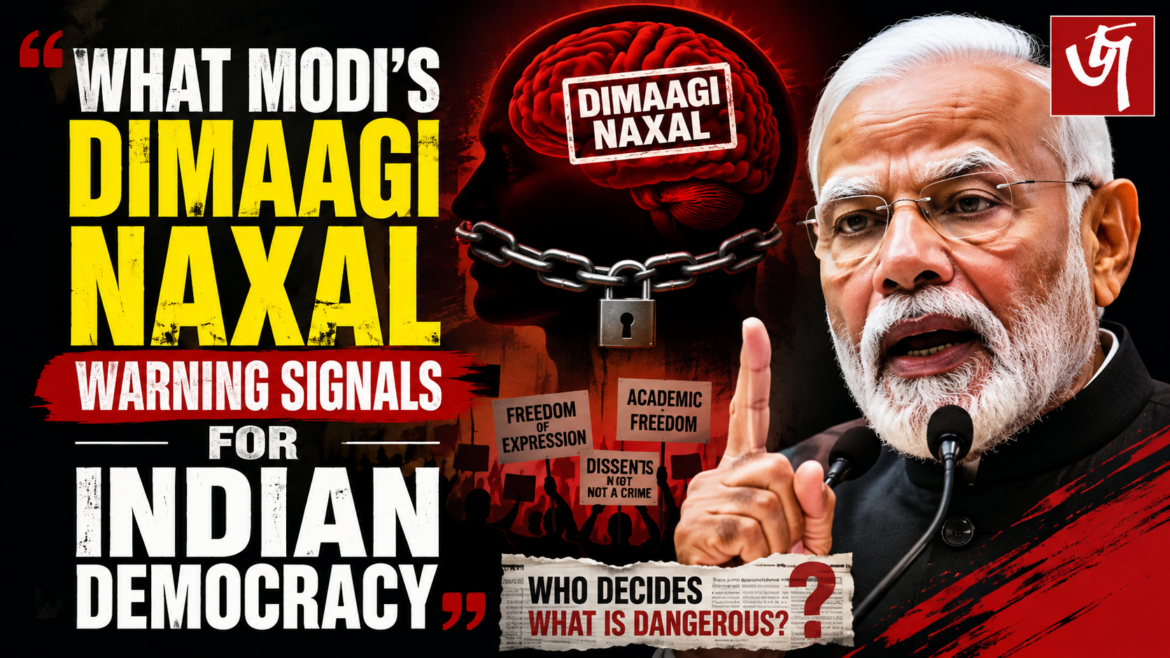
Prime Minister Narendra Modi’s 80th Independence Day address was designed as a manifesto for a confident, rising India — a blueprint focusing on economic transformation, energy security, youth empowerment, and the ambitious goal of a Viksit Bharat by 2047.
Yet, a single brief phrase from the ramparts of the Red Fort has ignited a fierce political debate.
Modi declared that while armed Naxalism had been effectively dismantled, “dimaagi Naxals” — loosely translated as “intellectual Naxals” — remained active and needed to be “identified and isolated.” Though fleeting, the remark carries profound implications. It raises a question that cuts far deeper than the fate of the Maoist insurgency:
Who gets to decide when political dissent crosses the line into a national security threat?
How the state answers this question will shape the boundaries of free speech, academic inquiry, and civil society in India for decades to come.
From the Gun to the Idea
The Prime Minister’s warning comes against the backdrop of an unmistakable operational victory.
According to government statistics, districts impacted by Left-Wing Extremism (LWE) have plummeted from 126 in 2014 to just two in 2026. The count of “most affected” districts has fallen from 35 to zero. Over the same period, Naxal-related incidents dropped from 870 to 234, while annual fatalities declined from 310 to 100. New Delhi attributes this success to a decade-long strategy combining targeted counter-insurgency, infrastructural expansion, improved governance, and proactive rehabilitation.
These figures reflect a dramatic structural shift. The Maoist insurgency that once paralyzed vast stretches of central and eastern India’s “Red Corridor” has been systematically broken. In regions like Bastar, long synonymous with violent conflict, the state has steadily expanded roads, telecom networks, and constitutional presence.
The retreat of armed violence is a significant internal security achievement. Yet, that very success makes the Prime Minister’s shift in terminology more consequential.
If the armed insurgency has been reduced to a fraction of its former self, why introduce a new threat category focused not on weapons, but on ideas?
From Naxalbari to the “Urban Naxal”
The word “Naxal” carries a specific historical weight, tracing its roots to the 1967 peasant uprising in Naxalbari, West Bengal. Over subsequent decades, various Maoist factions waged an armed rebellion that paired revolutionary ideology with violent resistance against the Indian republic.
By contrast, the modern term “urban Naxal” occupies a far more ambiguous, elastic terrain.
The label gained mainstream political traction following the 2018 Bhima Koregaon arrests. Since then, it has become shorthand in public discourse for individuals accused of providing ideological, financial, or logistical cover to underground networks.
The state indisputably has a duty to investigate and disrupt covert urban networks supporting illegal organizations. However, a vital line exists between prosecuting evidence-backed ties to an armed insurgency and applying a politically charged label to citizens based on their ideological stances.
That line becomes dangerously blurred when the terminology lacks any legal definition.
“Urban Naxal” does not exist as a legal category in the Ministry of Home Affairs’ statutes. While urban Maoist sympathizers may exist, a rhetoric-driven label cannot establish criminal liability, membership in a banned group, or unlawful acts under Indian law.
Maintaining that distinction is fundamental to a constitutional democracy.
A Label Without a Legal Boundary
The danger of elastic political terms lies not just in how they are applied today, but in how broadly they can be stretched tomorrow.
An armed combatant in the forest can be identified through tangible evidence: weapons, tactical organization, and criminal acts. An “intellectual Naxal,” however, remains entirely undefined.
-
Does it refer to an individual actively aiding a banned insurgent group?
-
Someone publicly advocating for violent revolution?
-
Someone expressing ideological sympathy with Marxist-Leninist thought?
-
Or simply a citizen challenging government policy from a radical, left-leaning perspective?
These are fundamentally distinct postures. The first two warrant law-enforcement intervention. The latter two belong squarely to the realm of open democratic debate. Without objective criteria, the line between subversion and dissent evaporates.
The Summer of Youth Protest
The timing of the Red Fort address adds another layer of complexity. The warning followed a summer marked by intense youth mobilization.
In July, widespread protests led by the Cockroach Janta Party over competitive examination irregularities and paper leaks escalated into a major national story. What began as a grievance over test integrity quickly grew into a broader outlet for youth frustration over economic prospects. The agitation culminated on July 25 with the resignation of Union Education Minister Dharmendra Pradhan — a key demand of the demonstrating students.
The episode proved that organized, social-media-literate youth movements could force political concessions from an administration that has historically projected steadfast resistance to public pressure.
Modi did not name the student movement, the CJP, or any specific university in his address. It would be an oversimplification to assume his words were directed at student activists. Nevertheless, the political context cannot be ignored. When a government emerges from a period of high-profile protest and immediately warns of an ideological threat that must be “identified and isolated,” public scrutiny regarding where national security ends and political policing begins is inevitable.
The Political Weight of “Isolation”
Perhaps the most key word in the Prime Minister’s speech was not “Naxal,” but “isolate.”
Every sovereign state has an obligation to isolate violent extremist groups, cut off their funding, and prosecute their members. But “isolating” an ideology operates on a completely different logic.
In a robust republic, contentious ideas are contested and defeated through debate, institutional checks, electoral politics, and superior arguments. The risk arises when the vocabulary of counter-insurgency is imported into the arena of civil disagreement.
Because “Naxalism” is linked to bloodshed, ambush, and anti-state warfare, applying the label to intellectuals, journalists, or critics instantly shifts the debate. It transforms a disagreement over policy into an accusation of treason.
What the Data Can—and Cannot—Tell Us
| Measure | Armed Naxalism | “Dimaagi” Naxalism |
| Verification | Measurable via incidents, casualties, and hardware | Ambiguous and open to political interpretation |
| Legal Status | Defined under anti-terror and criminal law | Non-statutory political terminology |
| State Action | Counter-insurgency operations & criminal prosecution | Ideological rhetoric, public labeling, and political isolation |
Official statistics can map the decline of an armed campaign. They cannot evaluate the legitimacy of an intellectual argument.
If individuals knowingly facilitate violence, illegal recruitment, or money laundering for an underground movement, the law must act decisively. But the state must scrupulously distinguish between a citizen facilitating violence and a citizen harboring unpopular, radical ideas.
Democracies stumble when they treat those two categories as the same thing.
The True Test of a Naxal-Free India
The government’s operational success against armed Maoism is clear and measurable. The harder test now lies ahead:
-
Can India maintain internal security without turning legitimate criticism into suspicion?
-
Can the state remain unyielding against violence while remaining open to ideological dissent?
-
Can it clearly differentiate between an armed insurgent in the field and an academic critic in a lecture hall?
These distinctions are not vulnerabilities; they are the hallmarks of a mature, confident republic.
The defeat of armed Naxalism ought to expand democratic space in regions long suppressed by fear, bringing infrastructure, constitutional rights, and public institutions to communities that missed out on both. By the same token, it should ensure that citizens across the country can question power without having their loyalty brought into question.
The guns may be fading from the forests of central India. The critical question now is what happens as the political focus moves from the battlefield to the mind. A truly Naxal-free India must not become a nation where critical thought itself is viewed as a threat to the state.