
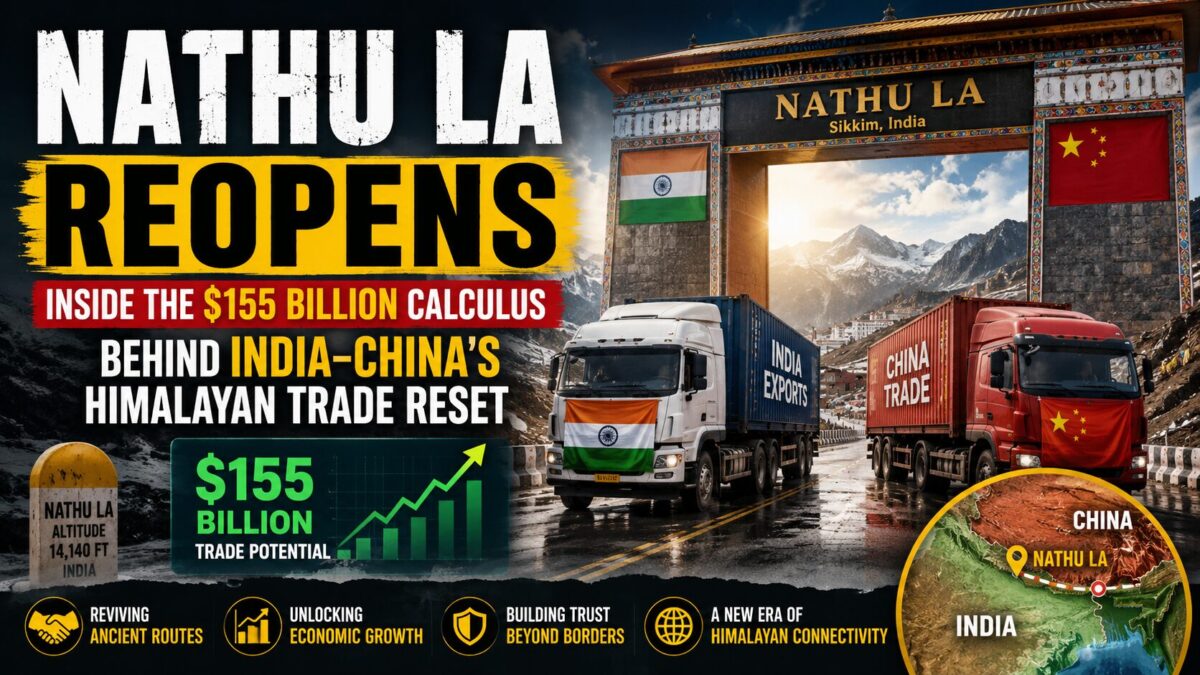
On August 1, 2026, trade convoys will once again cross the Nathu La Pass, 4,310 metres up in the Sikkim Himalayas, ending a shutdown that has lasted more than six years. Read as an isolated event, it looks like a minor administrative footnote — a seasonal trade mart reopening for a few hundred registered traders. Read against the backdup of a $155.6 billion bilateral trade relationship, a still-militarised Line of Actual Control (LAC), and a fast-shifting global tariff order, it looks like something else entirely: a calibrated signal that both New Delhi and Beijing have decided compartmentalized engagement serves them better than continued deadlock.
This piece unpacks the economic data, the diplomatic sequencing, and the strategic logic behind the reopening — and why it should be read as a tactical thaw, not a resolution.
A Six-Year Freeze, Now Ending on a Fixed Date
Border trade through Nathu La — along with the Lipulekh Pass in Uttarakhand and the Shipki La Pass in Himachal Pradesh — was suspended in 2020 as COVID-19 restrictions combined with the fallout from the Galwan Valley clash to freeze nearly all functional cooperation along the frontier. Six years on, Sikkim’s state government has confirmed that repairs to the Integrated Check Post and the Sherathang Trade Mart are complete, a trial run was scheduled for July 30, and the Indo-Tibetan Border Police has deployed additional personnel — including, notably, an all-women contingent — ahead of the formal reopening.
Roughly 600 registered Indian traders are expected to benefit directly from the resumption, alongside transporters, warehouse operators, and hospitality businesses along the Gangtok–Nathu La corridor. The trade list remains narrow and tightly regulated — wool, yak tails, borax, and a handful of other commodities on the Indian side; consumer manufactures and other approved items from the Tibetan side — a reminder that this is a symbolic and community-level channel, not a mechanism that will meaningfully dent the broader trade imbalance discussed below.
[Internal link suggestion: “How the Sivok–Rangpo Rail Line Is Reshaping Sikkim’s Connectivity”]
The Diplomatic Sequence That Made This Possible
The reopening did not emerge in isolation. It traces directly to the 24th round of the India–China Special Representatives’ Dialogue on the boundary question, held in August 2025 and co-chaired by National Security Advisor Ajit Doval and Chinese Foreign Minister Wang Yi, where both sides agreed to restore trade through all three Himalayan passes. That meeting followed the broader diplomatic recalibration set in motion by the Modi–Xi meeting in Tianjin in August 2025, and has since been reinforced by Foreign Secretary Vikram Misri’s July 27, 2026 visit to China for talks with Vice Minister Sun Haiyan, as well as the resumption of the Kailash Mansarovar Yatra through Nathu La after its own five-year hiatus.
External link: India’s Ministry of External Affairs — Special Representatives’ Dialogue statement
Seen in this sequence, Nathu La is less a standalone gesture and more the visible, low-risk output of a year-long normalization track that has been running largely below the headlines — one that has deliberately avoided touching the unresolved boundary question itself.
Why the Economic Backdrop Changes the Reading
The symbolism of Nathu La only makes sense against the scale of what already flows between the two economies through conventional channels. China overtook the United States in FY2025–26 to become India’s largest trading partner, with bilateral trade reaching $151.1 billion and India’s trade deficit widening to a record $112.16 billion — Indian exports to China grew 36.66% to $19.47 billion, while imports rose 16% to $131.63 billion. Calendar-year figures put total 2025 bilateral trade even higher, at roughly $155.6 billion, with China’s own ambassador to India attributing the 12% year-on-year growth partly to the post-Tianjin diplomatic reset.
The structural imbalance behind that headline number is stark and persistent. Research body GTRI has tracked India’s trade deficit with China widening from $64.7 billion in 2021 to an estimated $106 billion in 2025, driven by import dependence concentrated overwhelmingly — nearly 80% — in electronics, machinery, organic chemicals, and plastics.
External link: GTRI report on India’s China trade deficit
This is the paradox that frames Nathu La: India is simultaneously deepening economic dependence on China at the macro level while trying to diversify and de-risk at the micro and strategic levels — restricting Chinese investment screening, scrutinizing telecom and infrastructure contracts, and building alternate supply chains, even as bilateral goods flows hit record highs. A Himalayan trade mart moving wool and borax will not change that calculus. What it does is create a visible, low-stakes proof point that engagement is possible without conceding ground on the deficit or the border.
Reading China’s Motives Through Its Own Numbers
Beijing’s incentives here are also data-driven. China’s global trade surplus hit a record of roughly $1.2 trillion in 2025 even as U.S. tariff pressure intensified, pushing Chinese exporters to diversify aggressively toward Southeast Asia, Latin America, and Africa. Stabilizing its western periphery — including trade and pilgrimage access through Tibet — fits a broader Chinese strategy of reducing the number of active friction points it manages simultaneously while U.S.–China tensions dominate its external bandwidth. Reviving cross-border commerce at Nathu La costs Beijing little, generates local economic activity in the Tibet Autonomous Region, and lets China present an image of “stable periphery diplomacy” to both domestic and international audiences.
External link: China’s 2025 trade surplus data
Strategic Significance: Confidence-Building, Not Conflict Resolution
None of this alters the military reality along the LAC, where both sides maintain substantial troop deployments and infrastructure build-out continues on both sides of the frontier. The Galwan clash and the subsequent multi-year standoff in eastern Ladakh — which saw a partial disengagement only concluded around October 2024 — remain the reference point against which every subsequent gesture, including this one, is measured.
What Nathu La demonstrates is a specific and recognizable diplomatic technique: parallel-track engagement, in which economic and people-to-people channels (trade, the Kailash Mansarovar Yatra, high-level visits) are allowed to normalize even while the underlying territorial dispute stays frozen and unresolved. This is not unique to India–China relations — it mirrors patterns seen in other protracted boundary disputes worldwide, where functional cooperation is used to reduce the risk of miscalculation without requiring either side to alter its core territorial position.
[Internal link suggestion: “LAC Disengagement Timeline: What Changed Between 2020 and 2024”]
What to Watch Next
Three indicators will show whether this reopening deepens into something more durable or stays a one-off gesture:
- Trade list expansion — whether the approved commodity list at Nathu La is widened in subsequent seasons, signalling genuine intent to scale rather than merely restore pre-2020 status quo.
- Parallel pass performance — whether Lipulekh and Shipki La sustain comparable trading activity, indicating a coordinated policy rather than a Sikkim-specific gesture.
- LAC military posture — whether troop and infrastructure levels along the disputed frontier show any corresponding easing, or whether economic normalization and military hardening continue on entirely separate tracks, as they have since 2020.
Conclusion
The reopening of Nathu La is best understood as a carefully bounded confidence-building measure rather than a genuine reset in India–China relations. It sits inside a broader, still-fragile normalization process that includes renewed diplomatic dialogue, revived pilgrimage routes, and record — if deeply lopsided — bilateral trade. For Sikkim and India’s Northeast, it is a tangible economic opportunity. For the broader relationship, it is a signal that both capitals have concluded that managed engagement, even amid unresolved disputes and a $100-billion-plus trade imbalance, remains preferable to total disengagement. Whether that logic survives the next crisis along the LAC is the question that will actually determine the future of India–China relations — not the tonnage of wool crossing a Himalayan pass.
References
- India Today NE, “Sikkim’s Nathu La Border Trade to Resume from August 1 after Six-Year Hiatus,” July 28, 2026. indiatodayne.in
- RT, “India, China to Resume Border Trade on August 1,” July 27, 2026. rt.com
- NENow, “Sikkim: Border Trade Through Nathula Set to Resume After More Than Six Years,” July 2026. nenow.in
- Kihikila Current Affairs, “Nathu La Border Trade: India and China,” July 2026. kihikila.in
- Business Standard, “China Becomes India’s Top Trade Partner in FY26; Deficit Widens to $112 bn,” April 15, 2026. business-standard.com
- Whalesbook, “India-China Trade Hits Record $155B Amid Deepening Deficit,” February 4, 2026. whalesbook.com
- The Print, “China’s Trade Surplus Crosses Record $1.19 Trillion Despite Trump Tariffs,” January 15, 2026. theprint.in
- Business Standard, “India’s Trade Deficit with China May Reach $106 Billion in 2025: GTRI,” December 19, 2025. business-standard.com
- Embassy of India, Beijing, “Trade and Economic Relations.” eoibeijing.gov.in
- Deccan Herald, “Explained: India-China Trade Relations; Deficit Widens to USD 99.2 Billion,” August 30, 2025. deccanherald.com
Note: Figures on bilateral trade and deficit are drawn from Indian Ministry of Commerce data and independent think-tank estimates (GTRI), which vary slightly by measurement period (calendar year vs. fiscal year). Readers should treat both as directionally consistent rather than identical.