
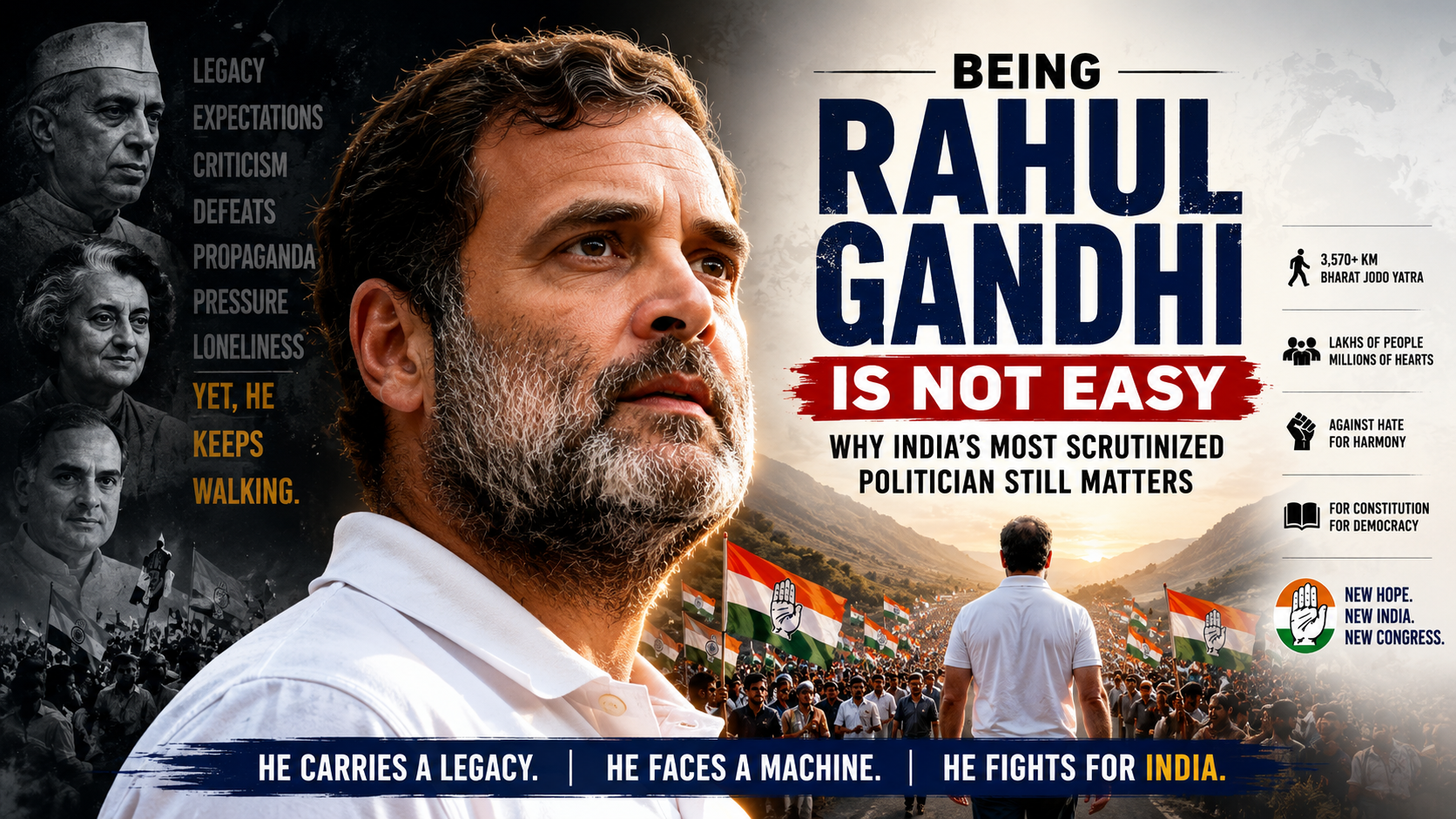
In the world’s largest democracy, few political figures have been scrutinized as intensely, mocked as relentlessly, or underestimated as consistently as Rahul Gandhi.
In modern politics, names can be both inheritance and imprisonment.
Few understand this paradox better than Rahul Gandhi.
For nearly two decades, the Indian politician has occupied a peculiar place in public life: simultaneously one of the most recognizable figures in the country and one of the most misunderstood. To his critics, he has often appeared as the reluctant heir to a fading political dynasty. To his supporters, he represents perseverance in the face of extraordinary hostility. To many neutral observers, he remains an unfinished political story.
Yet regardless of where one stands politically, one fact is difficult to dispute: being Rahul Gandhi is not easy.
In a nation where politics is increasingly defined by powerful personalities, relentless media cycles, and uncompromising ideological battles, Gandhi has had to carry burdens few democratic politicians anywhere in the world would envy. He inherited not merely a political party but the legacy of India’s most consequential political family, a dynasty that has shaped the republic since independence.
The challenge before him has never simply been winning elections. It has been surviving history.
The Curse and Privilege of Political Inheritance
Political dynasties are often discussed in terms of privilege. Less frequently discussed is the weight of expectation they impose.
Rahul Gandhi was born into a family that has produced three Prime Ministers. His great-grandfather, Jawaharlal Nehru, helped build the foundations of modern India. His grandmother, Indira Gandhi, remains one of the most powerful and controversial leaders in Indian history. His father, Rajiv Gandhi, embodied the promise of a modernizing India before his assassination in 1991.
Such a legacy provides instant recognition. It also creates impossible standards.
Every speech Rahul Gandhi delivers is measured against Nehru’s intellect, every political decision against Indira Gandhi’s authority, and every electoral performance against the Congress Party’s historic dominance.
Most politicians are permitted the luxury of being themselves. Rahul Gandhi has spent much of his public life being compared with ghosts.
The irony is that while critics often accuse him of benefiting from dynastic politics, the dynasty itself has frequently become his greatest political burden. His successes are dismissed as inheritance; his failures are personalized and magnified.
Few politicians anywhere in the democratic world have entered public life carrying such disproportionate expectations.
Defeat as a Political Education
If political careers are defined by victories, political character is often shaped by defeats.
Rahul Gandhi’s public life has been marked by a succession of electoral disappointments that would likely have ended the careers of many politicians.
The Congress Party’s collapse in the 2014 general election was historic. Reduced to just 44 seats in the Lok Sabha, the party suffered its worst performance since independence. Five years later, despite modest improvements, the 2019 election reaffirmed the BJP’s dominance and further deepened questions about Congress’s future.
For many observers, these defeats became proof of Gandhi’s political limitations.
Yet politics is filled with leaders who won elections. It is far less common to find leaders who remain politically relevant after repeated losses.
That is what makes Rahul Gandhi’s trajectory unusual.
Rather than retreating from public life, he gradually transformed his political style. The polished, occasionally hesitant politician of the early 2010s evolved into a more direct and confrontational public figure. His speeches became sharper. His criticisms of government policy became more consistent. His engagement with civil society became more visible.
Defeat, paradoxically, appeared to liberate him.
Freed from the immediate burden of electoral expectations, Gandhi increasingly positioned himself as a long-term political campaigner rather than merely an electoral contestant.
The Long Walk That Changed Perceptions
History occasionally rewards politicians not for what they say but for what they are willing to endure.
The Bharat Jodo Yatra was one such moment.
Beginning in September 2022 at Kanyakumari and concluding in Srinagar in January 2023, the march covered more than 3,500 kilometers across India. It was not the first political march in Indian history, nor was it guaranteed to produce electoral gains.
But its significance lay elsewhere.
At a time when politics had become increasingly digital, mediated through television studios, social media algorithms, and carefully curated messaging, Gandhi chose a strikingly analog method of engagement: walking.
Day after day, state after state, he met farmers, students, workers, activists, entrepreneurs, and ordinary citizens. Whether one agreed with his politics or not, the physical commitment required for such a journey commanded attention.
The Bharat Jodo Yatra achieved something many political campaigns fail to accomplish: it altered perception.
For years, Rahul Gandhi had been defined largely by his opponents. During the yatra, he began defining himself.
The march did not magically revive Congress. Political organizations are not transformed overnight. Yet it accomplished something potentially more important—it restored a connection between the party and segments of society that had gradually drifted away.
In politics, symbolism matters. The image of a national leader walking thousands of kilometers across a deeply polarized nation carried symbolic power that even critics found difficult to ignore.
Standing Against a Dominant Political Narrative
Modern democratic politics is increasingly shaped by narrative warfare.
Governments seek to define reality. Oppositions seek to challenge it.
Rahul Gandhi’s political significance today lies partly in his willingness to occupy that oppositional space at a time when many opposition leaders remain regionally confined.
His critics accuse him of negativity. His supporters describe him as one of the few national leaders consistently willing to question concentrated political power.
What is undeniable is that he has become one of the most persistent critics of the current political order.
Whether discussing economic inequality, institutional independence, unemployment, social cohesion, or constitutional governance, Gandhi has sought to frame political debates around broader questions concerning the direction of Indian democracy.
The effectiveness of these interventions remains contested. Their consistency does not.
Can Congress Be Revived?
The future of Rahul Gandhi is inseparable from the future of the Congress Party.
The challenge confronting Congress extends far beyond leadership. It is organizational, ideological, generational, and structural. Rebuilding a party that once dominated Indian politics but now faces powerful regional competitors and a formidable ruling party requires more than charisma.
It requires patience.
Increasingly, Gandhi’s strategy appears less focused on immediate electoral victories and more centered on rebuilding political infrastructure, strengthening grassroots networks, encouraging younger leadership, and forging broader opposition coalitions.
Whether this strategy ultimately succeeds remains uncertain.
Political revivals are rarely linear. The BJP itself spent decades in opposition before becoming India’s dominant political force.
The more relevant question may not be whether Congress returns quickly to power, but whether it can once again become a credible national alternative.
If that happens, Rahul Gandhi will almost certainly be one of the principal architects.
The Opposition’s Democratic Responsibility
Every democracy requires strong governments.
It also requires strong oppositions.
This may ultimately be Rahul Gandhi’s most important political argument.
Much of his recent political messaging has centered on constitutional values, institutional autonomy, federalism, civil liberties, parliamentary accountability, and democratic checks and balances. Critics may disagree with his diagnosis; supporters may embrace it enthusiastically. But the underlying premise—that democracy depends upon contestation—is difficult to dismiss.
In mature democracies, opposition leaders are not merely competitors for power. They are guardians of democratic debate itself.
Viewed through that lens, Gandhi’s political significance extends beyond elections.
His role is not simply to defeat the government. It is to ensure that dissent retains a place within the democratic conversation.
More Than an Heir
The easiest way to understand Rahul Gandhi is through his surname.
It is also the least interesting.
His political life has become a study in endurance: enduring criticism, enduring defeat, enduring caricature, and enduring expectations that would overwhelm most public figures.
Whether history ultimately judges him as a successful leader remains an open question.
But history often reserves a special place for politicians who refuse to disappear.
For much of the past decade, Rahul Gandhi has been written off, mocked, underestimated, and politically buried. Yet he remains central to India’s political conversation.
That persistence alone says something important.
In a political age increasingly defined by spectacle, outrage, and instant gratification, Rahul Gandhi represents something less fashionable but perhaps more enduring: the stubborn refusal to quit.
And perhaps that is why being Rahul Gandhi is not easy.
It is not merely the burden of carrying a famous name.
It is the burden of carrying it when much of the world expects you to fail.