
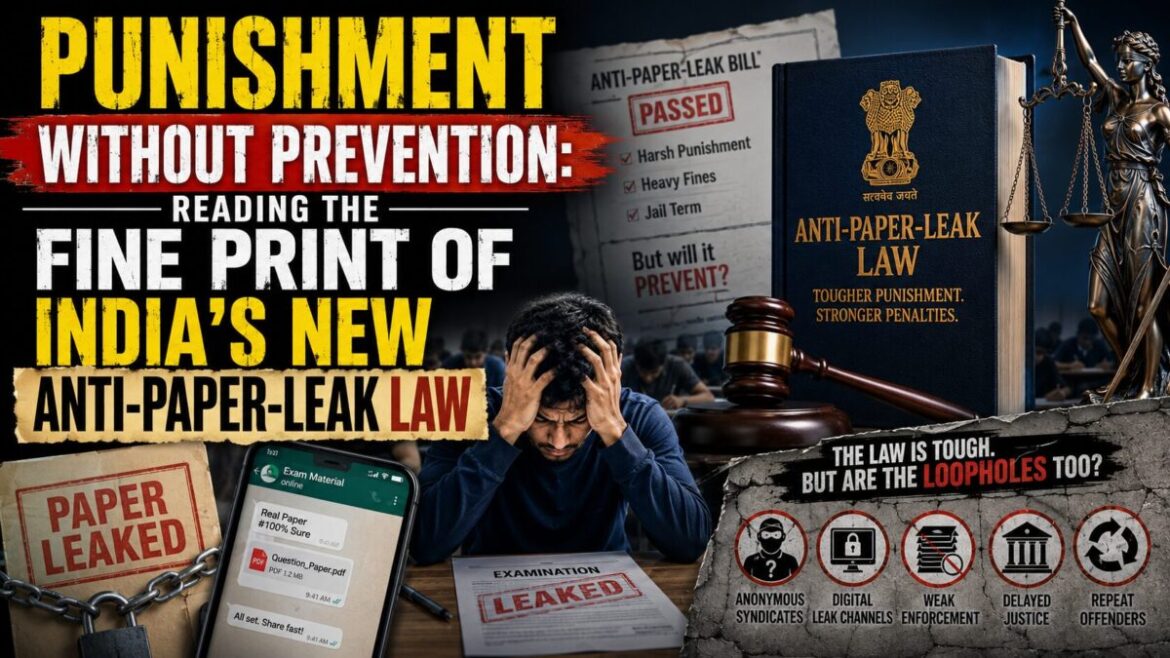
Executive Summary
On July 29, 2026, the Lok Sabha passed the Public Examinations (Prevention of Unfair Means) Amendment Bill, 2026 by voice vote, sending it on to the Rajya Sabha for concurrence. Piloted by Union Minister of State Dr Jitendra Singh, the Bill sharpens an already punitive 2024 law: minimum jail terms rise from three to five years and maximum terms from five to ten; fines for individuals jump from ₹10 lakh to ₹50 lakh; organised examination fraud can now draw fines running into crores; and investigators get a hard two-month deadline to file a chargesheet, with courts expected to deliver verdicts within roughly three months.
The Bill is the government’s direct answer to the NEET-UG 2026 controversy, which forced the National Testing Agency to cancel and re-conduct the May 3 exam, triggered CBI cases and nationwide student protests, and ultimately cost Education Minister Dharmendra Pradhan his job. It is, by any reading, the toughest anti-cheating statute India has produced. The open question — one Opposition MPs pressed hard during the debate — is whether toughness alone can stop a leak from happening in the first place.
1. What Changed, Precisely
The 2026 Bill amends the Public Examinations (Prevention of Unfair Means) Act, 2024 (Act No. 1 of 2024), which came into force on June 21, 2024, roughly six weeks before the very NEET-UG 2024 leak it was meant to deter — a sequencing worth pausing on, since it shows that a strict penal statute was already on the books when the last major scandal broke.
| Provision | 2024 Act | 2026 Amendment |
|---|---|---|
| Imprisonment for individuals | 3–5 years | 5–10 years |
| Maximum fine, individuals | ₹10 lakh | ₹50 lakh |
| Maximum fine, service providers | ₹1 crore | ₹5 crore |
| Fine for organised/institutional fraud | Not separately specified | Up to ₹10 crore |
| Debarment of service providers | 4 years | 8 years |
| Investigation timeline | No fixed statutory deadline | 2 months |
| Trial/appeal mechanism | Ordinary courts | Special Fast-Track Courts, Special Public Prosecutors, time-bound appeal disposal |
| Investigating authority | DSP/ACP rank officer; Centre could refer to a central agency | Centre may additionally constitute a dedicated Special Task Force |
Sources: PRS Legislative Research bill summary; PIB press releases dated July 28–29, 2026.
The core legislative philosophy is unchanged from 2024 — deterrence through severity — just recalibrated upward and given tighter procedural teeth.
2. The Trigger: NEET-UG 2026 and a Familiar Pattern
The Bill did not emerge in a vacuum. The NEET-UG 2026 exam was cancelled and re-conducted after leak allegations; the CBI opened an investigation, and as of the Lok Sabha debate, 13 people had been arrested with a chargesheet expected imminently. The political fallout was significant enough that it contributed to a ministerial resignation and a week-long parliamentary logjam before the Bill was even taken up.
This is not India’s first such episode. NEET-UG 2024 — taken by roughly 23.3 lakh candidates — had already generated multiple CBI FIRs and a Supreme Court hearing. That the country’s first dedicated central anti-leak law was in force before that scandal, and did nothing to prevent a near-identical one two years later, is itself the strongest empirical argument against treating this as primarily a sentencing problem.
3. What the Opposition Argued
The Bill passed by voice vote, but not without sustained pushback. Congress leader Rahul Gandhi and other Opposition members, coordinated through an INDIA bloc floor strategy led by Rajya Sabha LoP Mallikarjun Kharge, used the debate to press the government on accountability for the NEET-UG 2026 lapse itself rather than only future penalties. Shashi Tharoor argued for a broader overhaul of India’s examination architecture, urging a move away from reliance on a single, monolithic high-stakes test as the gateway to opportunity. More broadly, Opposition members contended — as one summary of the debate put it — that the law is weighted toward punishing offenders after a breach rather than fixing the administrative weaknesses that make breaches possible, a criticism the ruling side did not seriously dispute so much as pair with promises of parallel administrative reform.
There is a harder empirical version of this same argument. The government’s own two-month investigation deadline echoes similar timelines already written into the Bharatiya Nagarik Suraksha Sanhita, 2023 for rape and POCSO cases, and into the SC/ST (Prevention of Atrocities) Act, 1989. Yet, per the National Crime Records Bureau’s Crime in India 2024 report, more than 40% of cases pending investigation under these very laws at the end of 2024 had already been pending for over six months — well past their statutory deadlines. A time limit written into a statute is not the same thing as a time limit enforced by an under-resourced police and forensic system. Nothing in the current Bill materially expands the specialised cyber-forensic or fast-track judicial capacity needed to actually meet the new deadlines it imposes.
4. Where the Leaks Actually Happen
Every major Indian paper-leak scandal of the last decade — whether in state commissions or national tests — traces back to one of three structural chokepoints rather than to insufficiently harsh sentencing:
- Printing and packaging, where low-bid vendors selected under the lowest-cost (L1) tender model handle sensitive material with uneven security vetting.
- Logistics and storage, where physical papers pass through couriers, treasury strongrooms and local invigilators — any one of whom can compromise the chain.
- Digital and CBT infrastructure, where local exam-center servers, remote-access tools, and insider collusion at privately run computer-based-test centers have repeatedly been the point of failure, alongside plain old device-based cheating.
The 2026 Bill strengthens liability for service providers and institutional actors after something goes wrong at any of these points. It does not mandate pre-qualification security standards, cybersecurity audits, or procurement reform for the vendors who run these chokepoints in the first place — which is precisely the gap the Opposition, and independent policy commentary around the Bill, has flagged.
5. What Would Make the Deterrence Real
None of this makes the amendment worthless — certainty and severity of punishment do matter, and Special Task Forces plus fast-track courts are a genuine institutional upgrade over ordinary criminal process, provided they are actually staffed and funded. But turning the law’s intent into a system that prevents leaks rather than merely prosecuting them afterward would require three further steps that remain outside the Bill’s scope:
- Procurement reform. Replace L1 (lowest-cost) vendor selection for high-stakes exams with quality-and-cost-based selection, paired with mandatory cybersecurity and physical-security certification before a vendor is ever awarded a contract.
- An independent examination security authority, at both Union and state level, empowered to audit test centers, certify vendors, and standardise protocols across bodies as varied as the UPSC, SSC, NTA and state commissions such as the APSC — insulated from the political pressure that currently surrounds each individual scandal.
- Capacity, not just deadlines, for the justice system: dedicated cyber-forensic units and functioning fast-track courts sized to the caseload, so the Bill’s two-month and three-month timelines are operational commitments rather than aspirational ones — the NCRB data above suggests this is where the current framework is weakest.
Conclusion
The Public Examinations (Prevention of Unfair Means) Amendment Bill, 2026 is a legitimate, arguably overdue, tightening of India’s legal response to a problem that has now derailed two national testing cycles in three years and cost a Cabinet minister his post. Parliament was right to act quickly. But the 2024 Act’s failure to prevent the 2026 repeat is the clearest available evidence that criminal deterrence, however severe, is necessary but not sufficient. The next test of this law will not be how many years an offender eventually serves — it will be whether India runs a single national examination in 2027 without another leak to legislate against.