
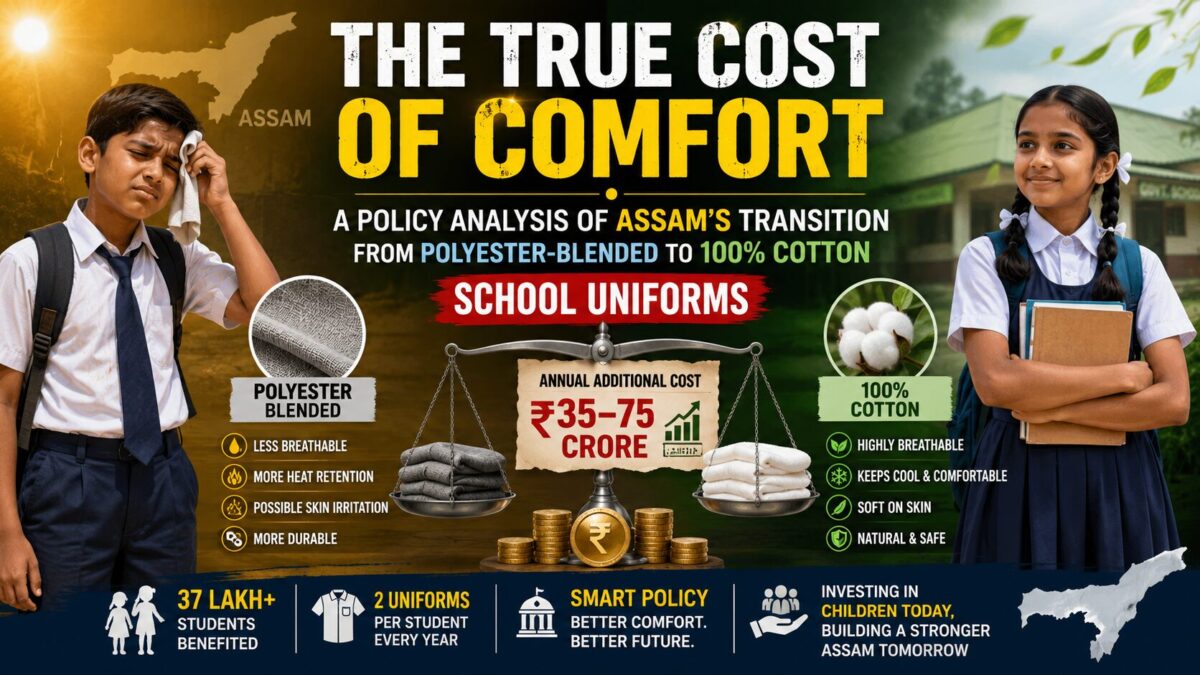
Every year, the Government of Assam takes on the massive logistical and financial feat of clothing more than 37 lakh (3.7 million) students under the Samagra Shiksha programme. For the 2026–27 academic year, this initiative carries a dedicated allocation of approximately ₹149 crore. The goal is simple yet profound: ensure every child has access to two free school uniforms.
However, beneath the surface of this welfare success story lies an escalating policy debate over fabric composition.
Currently, Assam’s state-issued uniforms utilize a 70% polyester and 30% cotton blend. While highly cost-effective and durable, this high-synthetic mix has sparked discussions regarding student comfort in Northeast India’s notoriously hot and humid climate. Critics and parents argue for a transition to 100% cotton, but the state’s education ministry warns that such a move would trigger severe budget expansions.
As a public policy analyst, evaluating this transition requires balancing human welfare against fiscal realities. What is the true cost of comfort? Let us break down the data.
The Current Balance Sheet
To understand the financial friction of switching to cotton, we must first establish the per-unit baseline of the current model. Based on official state figures, the arithmetic of the 2026–27 allocation reveals a lean, hyper-efficient procurement system:
- Total Budget Allocation: ₹149 crore
- Total Beneficiaries: 37,000,000+ students
- Uniforms per Student: 2
- Annual Cost per Student: ~₹403
- Production Cost per Uniform: ~₹201
At roughly ₹201 per uniform (covering fabric, stitching, logistics, and distribution), the current 70:30 polyester-heavy blend maximizes the purchasing power of public funds.
Projecting the Financial Impact of 100% Cotton
Because raw commodity and wholesale textile data fluctuate, exact government procurement margins are tightly guarded. However, analyzing prevailing wholesale textile market trends allows us to project the incremental cost curves across four fiscal scenarios.
Shifting entirely to 100% cotton would inevitably spike the annual budget from ₹149 crore to an estimated ₹170 crore to ₹225 crore.
| Fiscal Scenario | Estimated Fabric Cost Increase | Additional Annual Expenditure | Total Projected Budget |
| Conservative | 15% | ~₹22 crore | ₹171 crore |
| Moderate | 25% | ~₹37 crore | ₹186 crore |
| High | 35% | ~₹52 crore | ₹201 crore |
| Very High | 50% | ~₹75 crore | ₹224 crore |
An additional ₹35 crore to ₹75 crore annually may seem minor on a macro level—representing just a 0.1% to 0.2% increase in Assam’s total state budget. However, within the confines of the School Education Department, this is a heavy incremental expense. Every rupee diverted toward fabric composition is a rupee that must compete with other critical educational priorities, such as hiring teachers, repairing dilapidated rural school infrastructure, upgrading drinking water facilities, and funding digital classrooms.
Weighing the Trade-offs: Comfort vs. Durability
A policy change of this scale cannot be decided by a ledger alone. It requires weighing immediate physical benefits against long-term operational challenges.
The Benefits of 100% Cotton
- Climate Adaptation: Assam’s sub-tropical climate demands breathability. 100% cotton excels at sweat absorption, helping students regulate body temperature during grueling summer heatwaves.
- Dermatological Health: High-polyester blends trap heat and friction, which can exacerbate skin irritation, heat rashes, and eczema in sensitive children.
- Economic Multiplying: If the government mandates domestic or local sourcing, a shift to cotton could inject tens of crores into India’s agricultural and handloom sectors.
The Drawbacks of 100% Cotton
- The Maintenance Burden: Cotton wrinkles easily and requires regular ironing—adding a daily labor and electricity burden to low-income households.
- Shorter Lifespan: Pure cotton degrades quicker under frequent, harsh washing cycles compared to resilient polyester fibers. Uniforms may fray or tear before the academic year ends.
- Volatility: Cotton is a vulnerable crop. Annual price fluctuations driven by weather and global trade could destabilize the education department’s budget forecasting.
Hybrid Policy Frameworks for the Future
An immediate, binary leap from 70% polyester to 100% cotton is not the state’s only option. Policymakers should explore more nuanced, hybrid frameworks that deliver the best of both worlds:
- The Balanced 50:50 Compromise: Moving to an equal 50:50 polyester-cotton blend dramatically elevates breathability and softness while retaining the structural integrity, wrinkle resistance, and cost efficiencies of synthetic fibers.
- Geographic Targeting: The government could introduce 100% cotton uniforms exclusively in districts experiencing extreme summer temperatures, while maintaining the blended standard in milder, high-altitude, or hilly regions.
- Seasonal Allocation: Students could be issued one 100% lightweight cotton uniform for the grueling summer months and one durable, insulated polyester-cotton blend uniform for the winter season.
- Localization & Local Value Capture: By intentionally routing textile procurement to Assam-based weaving units and self-help groups, the state could transform a budgetary cost into an economic engine, creating thousands of local jobs.
The Bottom Line
From a pure public policy perspective, an immediate pivot to 100% cotton presents an admirable ideal but an unsustainable financial and operational strain for a developing education infrastructure.
The most pragmatic path forward is a 50:50 polyester-cotton blend. This middle ground directly addresses the physiological comfort of Assam’s school children, protects the longevity of the garments for working-class parents, and preserves vital state funds to build the modern schools those very students deserve.