
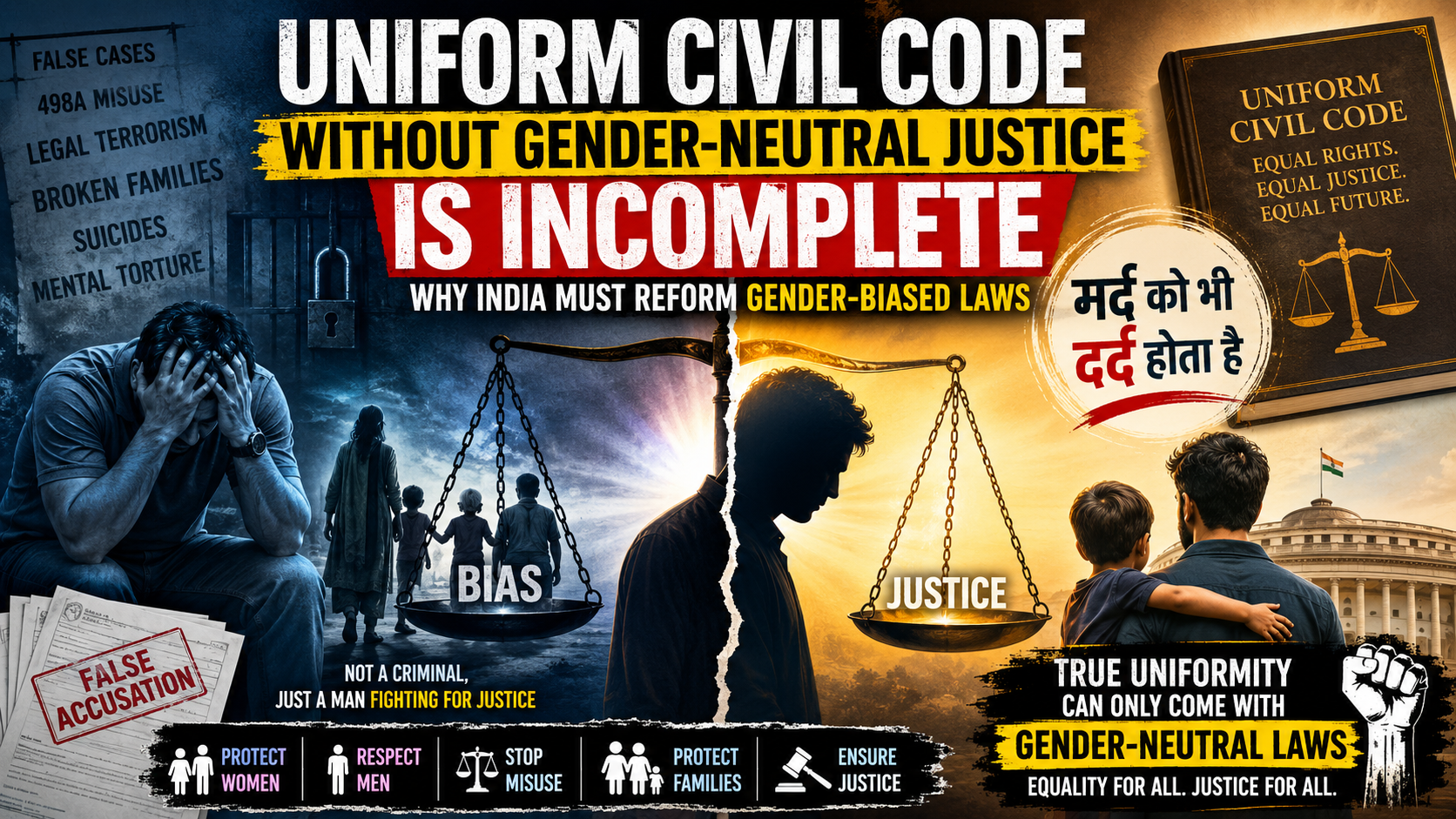
Uniformity Without Equality Is Meaningless
The debate around the Uniform Civil Code (UCC) has intensified in recent years. Supporters view it as a necessary constitutional reform to bring legal uniformity across religions in matters such as marriage, divorce, inheritance, adoption, and maintenance. The core objective of the UCC is rooted in Article 44 of the Indian Constitution, which urges the State to strive toward a common civil code for all citizens.
However, an uncomfortable but increasingly important question remains largely ignored in public discourse:
Can India truly achieve equality through a Uniform Civil Code if the legal system itself remains gender biased?
The answer is no.
Uniformity in law does not automatically guarantee justice. A law can apply equally to all communities yet still discriminate on the basis of gender. In India, several legal provisions, welfare frameworks, and judicial presumptions continue to operate primarily from the assumption that men are perpetrators and women are victims. While these laws were originally enacted to protect vulnerable women in a patriarchal society, growing evidence suggests that misuse, imbalance, and lack of gender neutrality are causing suffering not only to men, but also to elderly parents, sisters, and children connected to accused males.
If India genuinely wishes to establish constitutional equality, then gender neutrality must become the foundation of future legal reform.
The Constitutional Promise of Equality
The Constitution of India guarantees equality before law under Article 14 and prohibits discrimination under Article 15. Yet, several criminal and civil laws continue to classify individuals primarily through gendered assumptions.
The contradiction is evident:
- Equality is promised constitutionally.
- But legal remedies are often gender specific.
- Punishments and protections are not always balanced.
- Male victims frequently lack recognition under law.
This contradiction becomes particularly relevant in the context of UCC discussions.
If the State argues that laws should not differ based on religion, then why should justice differ based on gender?
Gender-Biased Laws: A Growing Concern
Section 498A and Allegations of Misuse
One of the most debated examples is Section 498A of the Indian Penal Code, now incorporated within the new criminal law framework under the Bharatiya Nyaya Sanhita.
The provision was introduced in 1983 to protect married women from cruelty and dowry harassment. Its intent was unquestionably noble. However, over the years, courts themselves have repeatedly acknowledged instances of misuse.
In the landmark case Arnesh Kumar vs State of Bihar (2014), the Supreme Court of India warned against automatic arrests under Section 498A and observed that the provision had sometimes become a tool of harassment rather than protection.
The Court famously referred to the misuse of the law as “legal terrorism” in earlier observations made in Sushil Kumar Sharma vs Union of India.
Several concerning patterns emerged over time:
- Entire families of husbands being implicated in complaints.
- Elderly parents facing arrest despite limited involvement.
- Sisters living abroad being named in FIRs.
- Long legal battles ending in acquittals after years of social humiliation.
National Crime Records Bureau (NCRB) data over the years has consistently shown relatively low conviction rates in many matrimonial dispute-related cases compared to the number of arrests made. While acquittal does not always mean a false case, it certainly raises questions about procedural fairness and misuse.
Domestic Violence Laws: One-Sided Recognition of Victims
The Protection of Women from Domestic Violence Act recognizes women as victims and men as respondents. A man facing domestic abuse from his spouse currently has no equivalent civil remedy under this law.
This creates a major legal vacuum.
Male victims of emotional abuse, coercive control, financial exploitation, or physical violence often avoid reporting due to:
- Fear of ridicule
- Social stigma
- Lack of legal recognition
- Fear of counter-cases
Several psychologists and family counselors have pointed out that domestic abuse is not always gender specific. Yet the legal framework often assumes otherwise.
True equality demands recognition that abuse can occur irrespective of gender.
Sexual Violence Laws and the Absence of Gender Neutrality
Indian rape laws remain largely gender specific. Under current law:
- A man cannot legally be recognized as a rape victim in many circumstances.
- Forced sexual acts against males are often prosecuted under lesser provisions.
- Male survivors of sexual abuse face severe institutional invisibility.
Many countries, including the United Kingdom, Canada, and Australia, have already moved toward gender-neutral sexual offence laws.
India’s resistance to such reform reflects outdated assumptions that victimhood belongs only to women and criminality only to men.
The Silent Victims: Families of Accused Men
One of the least discussed consequences of gender-biased legal structures is the suffering of women related to accused men.
When a man faces legal proceedings in matrimonial or domestic disputes, the impact extends far beyond him.
Elderly Mothers
Thousands of elderly mothers become collateral damage in prolonged legal conflicts:
- Arrest fears
- Court appearances
- Financial exhaustion
- Social humiliation
- Health deterioration
In many cases, senior citizen women are named in complaints despite age or medical vulnerability.
Ironically, laws designed to protect women sometimes end up victimizing other women.
Sisters and Female Relatives
Married sisters living separately are frequently dragged into litigation due to family association. Courts have repeatedly criticized the tendency to implicate every member of a husband’s family without specific allegations.
Such practices:
- destroy family relationships,
- increase judicial burden,
- and weaken the credibility of genuine complaints.
Children as Psychological Casualties
Children trapped in hostile legal battles often become the biggest emotional victims.
Prolonged matrimonial disputes can lead to:
- depression,
- parental alienation,
- academic decline,
- emotional insecurity,
- and lifelong psychological trauma.
In many custody battles, fathers also struggle for meaningful parental access despite growing global recognition of shared parenting principles.
Why Gender Neutral Laws Do Not Mean Anti-Women Laws
A major misconception in public debate is that gender-neutral laws would weaken women’s protection.
This is false.
Gender neutrality does not mean ignoring historical disadvantages faced by women. Instead, it means:
- recognizing every genuine victim,
- punishing every genuine offender,
- and ensuring procedural fairness for all.
A gender-neutral legal system can still:
- provide special safeguards where necessary,
- protect vulnerable individuals,
- and address social inequalities.
But it would avoid automatic assumptions based purely on gender.
Justice must depend on evidence, not stereotypes.
Global Democracies Are Moving Toward Neutrality
Several democratic nations have already recognized the importance of gender-neutral legal frameworks:
- United Kingdom has gender-neutral domestic violence and harassment laws.
- Canada recognizes abuse irrespective of gender.
- Australia has increasingly adopted inclusive legal terminology.
- Many European nations now focus on “persons” rather than “men” or “women” in civil protection frameworks.
India, aspiring to become a global democratic leader, cannot remain trapped in outdated binaries.
UCC Must Go Beyond Religious Uniformity
The current UCC debate largely revolves around:
- religion,
- personal law reform,
- polygamy,
- inheritance,
- and marriage practices.
But a truly modern civil code must also address:
- equal parental rights,
- gender-neutral domestic violence protections,
- fair maintenance laws,
- shared parenting,
- protection against false accusations,
- and recognition of male and LGBTQ victims.
Otherwise, UCC risks becoming only a cosmetic reform.
Uniformity without fairness merely creates standardized inequality.
The Need for Balanced Legal Reform
India does not need a rollback of women’s rights. Women in many parts of society still face discrimination, violence, and structural disadvantages. Protective laws remain necessary.
However, the legal system must also acknowledge:
- false implication exists,
- misuse exists,
- male victimhood exists,
- and procedural imbalance exists.
A mature democracy must be capable of protecting women without demonizing men.
Balanced reform requires:
- Gender-neutral drafting of laws wherever possible.
- Strict punishment for false complaints.
- Equal recognition of all victims.
- Better investigation standards.
- Faster disposal of family disputes.
- Shared parenting frameworks.
- Mental health support for affected families.
Equality Must Be Real, Not Selective
The vision of the Uniform Civil Code should not stop at religious uniformity. The larger constitutional goal must be equal justice for every citizen irrespective of gender, religion, caste, or community.
India cannot claim to uphold Article 14 while maintaining laws that presume innocence or guilt primarily through gender identity.
True constitutional morality demands courage:
- courage to protect women,
- courage to acknowledge male suffering,
- and courage to reform outdated legal assumptions.
A truly progressive India will emerge not when laws become identical across religions alone, but when justice itself becomes genuinely gender neutral.
Only then will the constitutional promise of equality become meaningful in practice.
Only then will India move closer to true justice under law.