
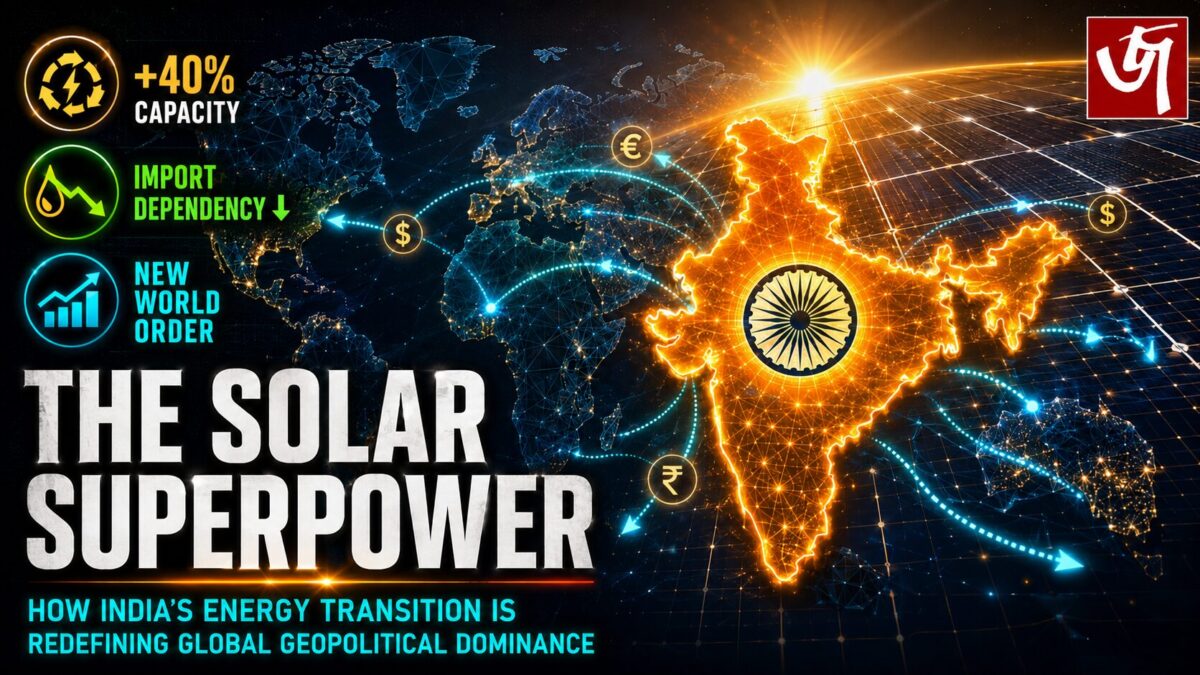
For decades, the calculus of global power has been written in barrels of oil and tons of coal. A nation’s geopolitical weight was often directly proportional to its access to fossil fuels. However, the global order is undergoing a structural transformation, and India is uniquely positioned to capitalize on this shift. By aggressively pivoting toward solar energy, India is not merely addressing climate change; it is fundamentally altering the drivers of its economic sovereignty and geopolitical influence.
The Geopolitical Rationale for the Solar Pivot
India’s historical reliance on imported petroleum and coal has represented a structural vulnerability. The country imports roughly 80% of its crude oil and a significant portion of its coal, creating supply chain fragility and exposing the economy to price volatility dictated by cartels or geopolitical conflict.
However, the global energy transition presents India with an opportunity to disrupt this dynamic. The pursuit of solar dominance is not just about replacing megawatts; it is about achieving foreign policy autonomy. By reducing its status as a “price taker” in volatile energy markets, India can buffer its macroeconomic stability against external shocks. More critically, the global supply chain for solar technology is becoming a new theater for geopolitical competition. Currently, the production of solar cells and modules is concentrated largely in China. India’s strategic objective, therefore, must be to become a manufacturing hub—not just to power its own growth, but to control a strategic resource for the rest of the globe.
In the diplomatic arena, this transition allows India to move beyond the binary of “oil-consuming” vs. “oil-producing” nations. As a leader in renewable deployment, India can forge new alliances with resource-rich nations in Africa or the Middle East—not as a dependent, but as a partner in green infrastructure and technology transfer. This enhances India’s soft power in the Global South while maintaining strategic leverage with traditional power blocs in the West.
Pathways to Energy Self-Reliance: A Policy Agenda
To translate this potential into reality, policy makers must move beyond production targets to systemic transformation. Self-reliance in energy requires a three-pronged strategy: technological sovereignty, grid modernization, and financial innovation.
- Building a Sovereign Supply Chain (PLI 2.0): The Production Linked Incentive (PLI) scheme is a strong start, but it must evolve into a full-fledged “Solar Atmanirbhar Bharat” mission. This entails shifting incentives from mere assembly of imported cells to integrated manufacturing of polysilicon, wafers, and ingots. India must impose strategic tariffs that reward domestic value addition while utilizing trade diplomacy to secure rare earth minerals critical for solar storage.
- The Green Grid and Storage Infrastructure: Solar energy is intermittent. Complete self-reliance is unachievable without a massive overhaul of the grid infrastructure. The government needs to mandate “storage mandates” alongside renewable capacity additions. This includes incentivizing Pumped Storage Projects (PSPs) and scaling up battery manufacturing through schemes like the ACC (Advanced Chemistry Cell) PLI. A smart grid with real-time balancing mechanisms is essential to handle the fluctuating load.
- Decentralization and Consumer Empowerment: True energy independence involves the citizen. Policies must push for “solar cities” and rooftop solar adoption, particularly for industrial and commercial consumers. The recently launched PM Surya Ghar scheme aims to electrify homes with solar, but it needs to be streamlined with net-metering regulations that are consumer-friendly. Democratizing energy production reduces the burden on the central grid and creates resilience at the local level.
- Green Hydrogen as a Bridge: For heavy industry and transport, direct electrification is difficult. India’s National Hydrogen Mission needs to be tied tightly to solar parks. Using solar power to produce green hydrogen can make India a net exporter of energy rather than an importer, fundamentally altering its trade balance.
- Financial De-risking: Capital costs for renewables remain high. The establishment of a “Green Finance Authority” to guarantee loans and securitize renewable assets is necessary. Lowering the cost of capital for Indian solar firms can make them globally competitive and attract sovereign wealth funds looking for ESG-compliant assets.
Conclusion
India’s path to global geopolitical dominance hinges on its ability to turn the energy crisis into an energy opportunity. By decoupling economic growth from fossil fuel imports, India is not just securing its energy needs; it is defining a new model of development. The nation that masters the solar economy will likely write the rules of the next global era. For India, the sun is not just a source of power; it is a strategic asset.
Internal Links
- [India’s Green Hydrogen Mission: A Deep Dive]
- [The Economics of the PLI Scheme in the Renewable Sector]
- [Understanding Net Metering for Indian Consumers]
- [Energy Storage: The Key to India’s Renewable Future]
External References
- International Energy Agency (IEA) – India Energy Outlook
- Ministry of New and Renewable Energy (MNRE) – Annual Reports
- World Bank – Scaling Up Renewable Energy in India
- Council on Energy, Environment and Water (CEEW) – Solar Policy Reports
Disclaimer: This analysis is for informational purposes only and does not constitute financial advice. The policy recommendations are based on current economic models and data available at the time of writing.